
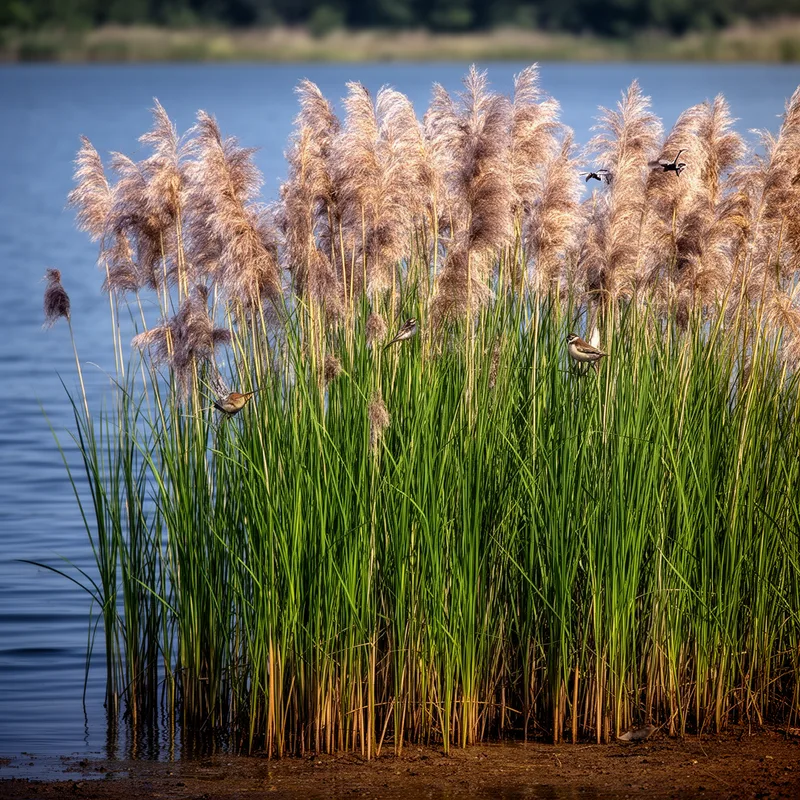
common reed
- noun
- /ˈkɑːmən riːd/
- Like switchgrass and johnsongrass, giant and common reed also share most agronomic or invasive characteristics (Table 2).
Examples
-
The common reed grows in wetlands and is often used to make thatch for roofs.
-
In the marshes, the tall common reed sways gently in the breeze, providing shelter for various birds.
-
The favored plant for reed beds in the UK is Phragmites australis, which is the common reed.
Academic text (1995) -
Giant and common reed share invaded habitats in their introduced ranges, and they both display extraordinary growth rates and biomass production that threaten the health of riparian corridors and wetlands.
Academic text (2008) -
Craftspeople harvest the common reed to create beautiful mats and screens for decoration.
Synonyms

 29
1.9
29
1.9

A tall grass with hollow stems that grows near water


 1
9.9
1
9.9
A tall reed with broad leaves and feathery flowers used to make mats and arrow shafts

A tall reed with broad leaves and feathery flower heads that grows in wetlands

A tall plant in wet places with long leaves and feathery flowers used to make mats and arrow shafts
Surface Forms
Morphology
The phrase is directly compositional: 'common' (widespread) modifies 'reed' (a tall grass), so the compound simply denotes a reed species that is widespread. This standard adjective + noun combination follows ordinary English composition and is cross-linguistically transparent, so a B1 learner who knows the constituents will understand it.
Etymology
Common reed is a very literal name: reed is a tall grass that grows in wet places and common means 'widespread'. People have long used it to make mats, screens and arrow shafts, so the name explains why we call this useful, tall grass the common reed.