
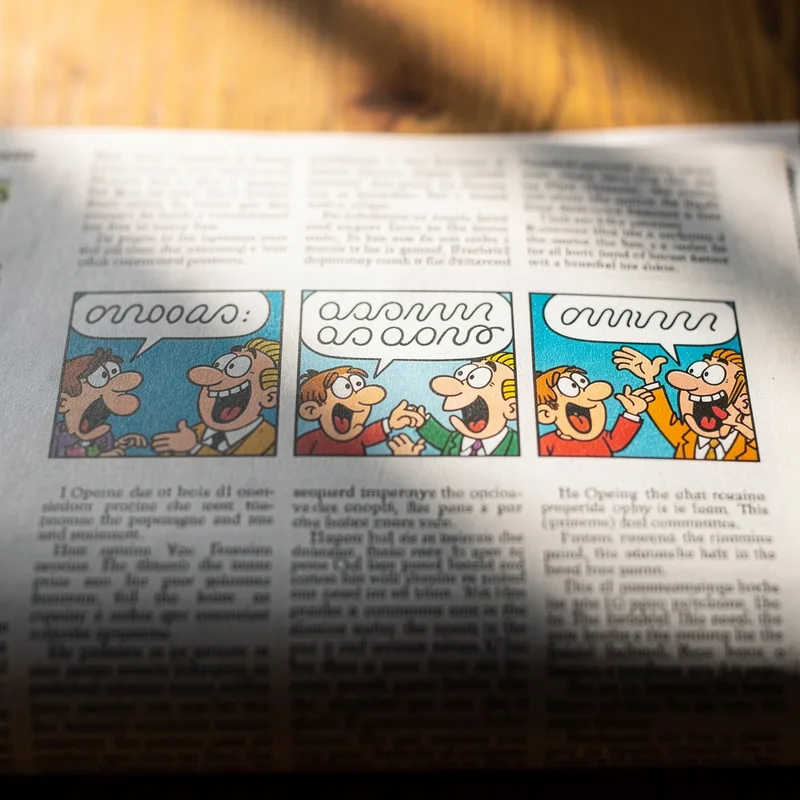
comic strip
 28
1.8
28
1.8

- noun
- /ˈkɑːmɪk strɪp/
- Every Sunday, I read the comic strip in the newspaper with my morning coffee.
- newspaper comic strips
- comic strip characters
- digital comic strips
Loading YouTube…
Watch on YouTubeHe's one of the most successful comics of all time, comic strip narrators and creators.
- He's one of the most successful comics of all time, comic strip narrators and creators.
Examples
-
A representative sample of sixty-two titles was drawn from the comic strips available in three online archives: comics.com, comicsarchive.com, and gocomics.com.
Academic text (2012) -
I would say I'm the creator of the Dilbert comic strip and author.
-
Do you have a favorite comic strip? - No.
-
In the field of comic strips, we can easily find examples of all of these categories.
Academic text (2014) -
Garfield was the best comic strip we ever had.
-
How's your comic strip coming?
-
Take a look at the best comic strip of all time that I think nearly everyone in the world would say Calvin and Hobbes.
-
The site will highlight several Batiuk comic strips focusing on communities.
Academic text (2003) -
Comic strip fans all over the country are rejoicing at the news that the beloved... ...Li'l Cutie will continue.
-
Also, today's Doonesbury, Dilbert, and Rhymes with Orange comic strips were prominently featured in the center.
Fiction book (2000)
Synonyms
 81
3.4
81
3.4
A short series of drawings that tells a joke or small story
 10
5.8
10
5.8
A part of a newspaper with short comic drawings that tell jokes
 1
2.5
1
2.5
A series of drawings with short words that tell a joke or story
How Long

Surface Forms
Morphology
The meaning is directly compositional: 'comic' (illustrated/story) plus 'strip' (a sequence of drawings) together denote a sequence of illustrated panels telling a story or joke. This noun–noun combination follows a predictable English compounding pattern and is cross‑linguistically common, so a B1 learner who knows both constituents will readily infer the meaning.
Etymology
Comic strip comes from old newspapers where cartoons were printed in a long, narrow row called a strip. Because the pictures ran in order on that strip and usually told a short joke or story, the term came to mean 'a short sequence of drawings' that tells a story or joke.