
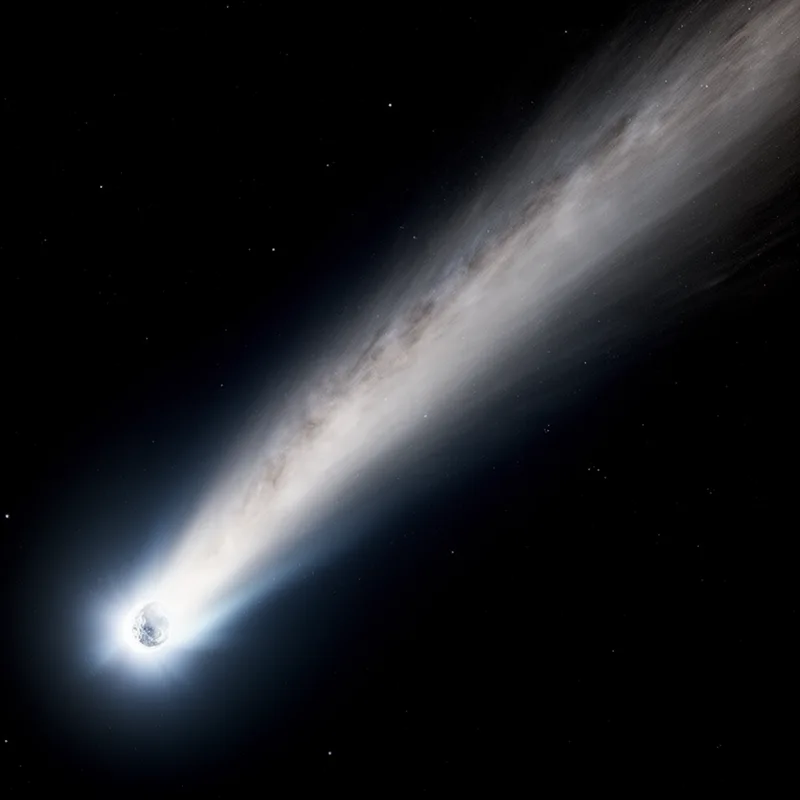
comet
 390
4.3
390
4.3

- noun
- /ˈkɒmɪt/
- The scientist explained how a comet forms a tail when it approaches the Sun.
- comet's ice
- comet's tail
- comet's orbit
Loading YouTube…
Watch on YouTubeMeteorites and comets could and did reach it.
- Meteorites and comets could and did reach it.
- And until then, happy comet hunting everybody.
- And people ask me, OK, well, this one, which is named Borisov, this comet is familiar.
- Also, the shape of a MUA MUA is rather untypical for asteroids or comets.
- OK, Now if you go back to Gustav Moreau's painting, he's showing us exactly when the comet came.
Examples
-
His thousands of photographs of comets provided a rich resource for generations of researchers.
Academic text (1992) -
And people ask me, OK, well, this one, which is named Borisov, this comet is familiar.
-
If life were on a comet, would we know it?
-
A planet that was once a comet, as you can see.
-
I thought I saw that comet.
-
Of course, we know now that the comet fell far short of these early estimates.
Academic text (1992) -
Take a look, there's a comet headed directly towards Earth.
-
Now, however, we can send spacecraft directly to comets and make in situ measurements.
Academic text (1992) -
The United States' involvement with Comet Halley received another disastrous blow in early 1986.
Academic text (1992) -
For one thing, yes, water was acquired by the Earth by comets and asteroids that slammed into the Earth.
How Bright
756
1.0
 ∞
1.0
∞
1.0
- Specialized
5
4.4
∞
1.0
390
4.3
314
5.0
Surface Forms
Etymology
Comet comes from the Greek kometes, from kome meaning 'hair'. Ancient people called it a 'hairy' star because the bright tail looks like long hair, which is why a comet today is the icy space object often seen with a long tail.