
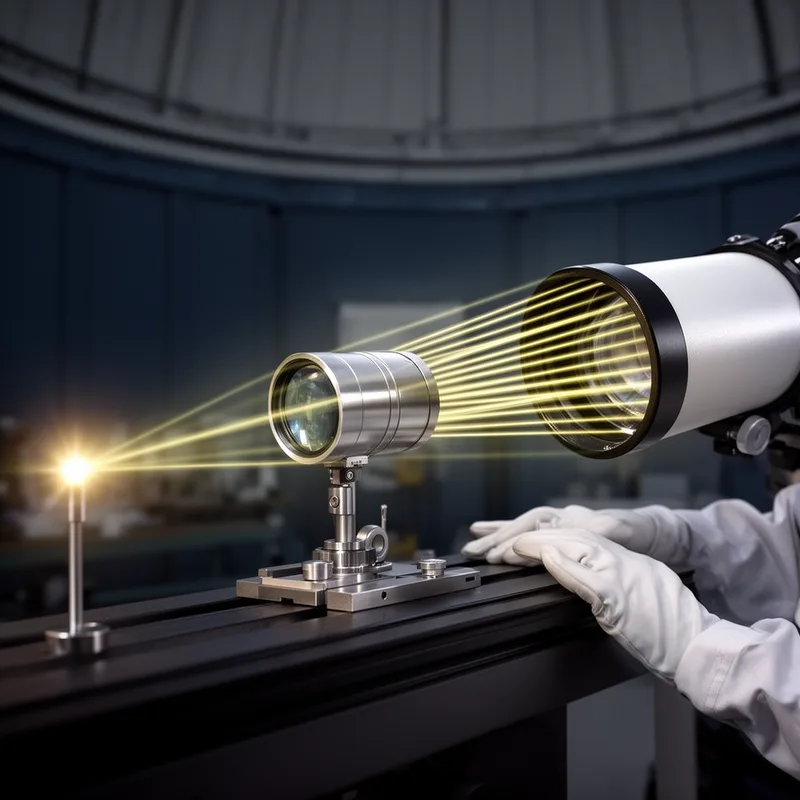
collimator


 1
9.9
1
9.9
- noun
- /ˈkɒlɪˌmeɪtə/
- Specialized
- Therefore, it's impractical to use collimators to select the highest photon energies.
- a multileaf collimator
Examples
-
They mapped the sky by allowing the spin of the rocket to sweep the collimator across the stars.
Academic text (1991) -
In this mode, the instrument pointing capability is used to position the source at several places in the field of view and use the known angular response of the collimator to determine the best fit location of the source in the sky.
Academic text (1990) -
There it encounters a collimator, an experimental nuclear target, and a monitor.
Academic text (2005) -
As pointing controls were developed for the rockets, it became possible to concentrate the observations on individual sources while the collimator reduced the background signal.
Academic text (1991) -
An ionization chamber immediately below the primary collimator produces current that is integrated and digitized to control the treatments.
Academic text (2002) -
Motorized block collimators reduce the field to a rectangle that circumscribes the irradiation area.
Academic text (2002) -
To map the Sun at high energies, RHESSI relies on rotating modulation collimators.
Academic text (2003) -
We used a GE Starcam XC/T (USA) y-camera with a low-energy all-purpose collimator with a large field of view.
Academic text (1995) -
The engineer used a collimator to align the laser beam for precise measurements.
-
The new collimator helped produce a parallel beam of light for the optical experiment.
Synonyms
 1
4.1
1
4.1
A device with lenses or mirrors that helps you see things clearly
Antonyms
How Parallel

Surface Forms
Morphology
Etymology
Collimator comes from the verb collimate, which meant 'make into a straight line' or 'align'. A helpful way to remember it is to think of com- 'together' plus the idea of a 'line' — a collimator makes light rays run in the same line, so it is used to align instruments or to produce a parallel beam.