
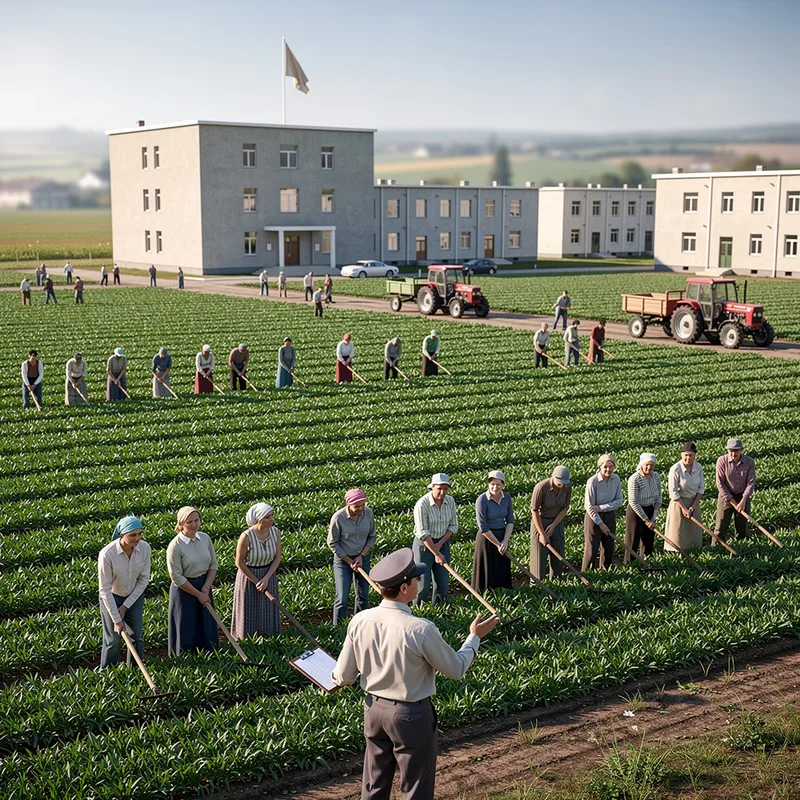
collective farm
 4
6.3
4
6.3

- noun
- /kəˈlɛktɪv fɑrm/
- Archaic
- And thousands of factories, collective farms, and state farms remain afloat on government grants and subsidies, draining the country of its lifeblood.
- collective farm and state
Loading YouTube…
Watch on YouTubeAnd these communes, you know, were enormous conglomerations of essentially collective farms.
- And these communes, you know, were enormous conglomerations of essentially collective farms.
Examples
-
Women and little kids from the collective farm harvested flax.
Fiction book (1995) -
Later, the Russians caught me and sent me to a collective farm.
-
There was a collective farm in the village.
Fiction book (1995) -
The collective farm had a truck, and the chairman of the collective farm went to wake up the driver.
Fiction book (1995) -
Some individuals work on collective farms in this capacity, and most families have their own small plots.
Academic text (2006) -
The early victims of the collective farms in the communist world figured this out a long time ago.
Blog text (16) -
She said she's escaped from a Russian collective farm.
-
In postwar Yugoslavia, the government put pressure on the organization of agriculture and fishing, trying to develop collective farms after the Soviet model.
Academic text (1993) -
After the revolution, many people were assigned to work on collective farms to support the new agricultural policies.
-
In the Soviet Union, a collective farm would usually have several families working together to manage the land.
How Communal

Surface Forms
Morphology
The meaning of 'collective farm' is directly derivable from 'collective' (run by a group) + 'farm' (a tract of land for agriculture), so a B1 learner who knows both words can infer it refers to a farm operated collectively. While the term may carry specific historical/political connotations (e.g., Soviet kolkhozy) that require background knowledge, the basic referent is compositionally transparent and cross-linguistically accessible.
Etymology
Collective farm combines collective, meaning shared by a group, and farm, meaning land worked to grow food. In the Soviet Union the government joined many small farms into one large farm where people worked together and shared tools and animals. So, collective farm means a farm 'run together by many people' or 'controlled by the government'.