
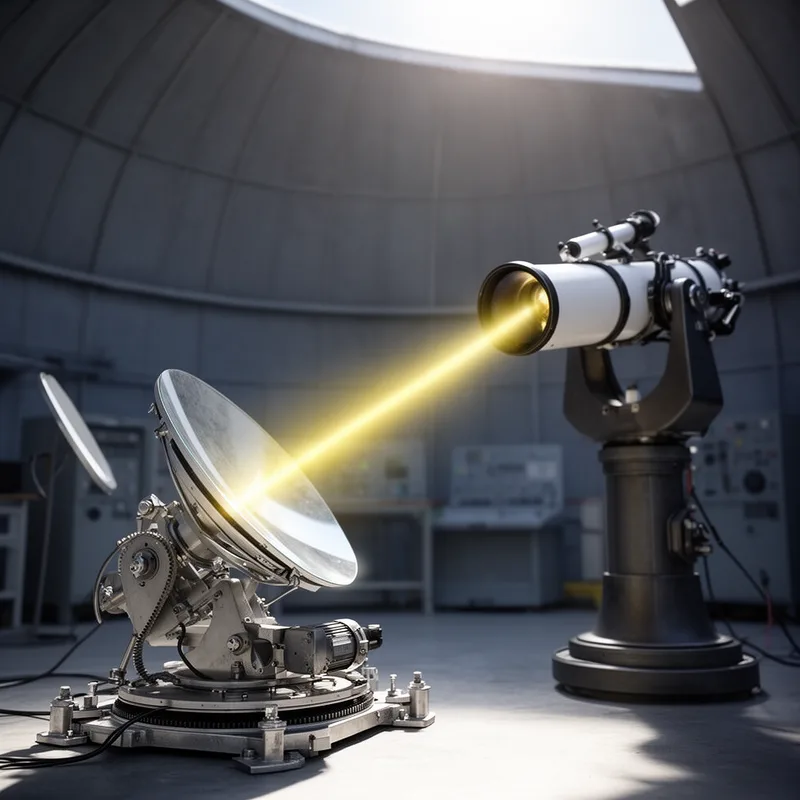
coelostat
- noun
- /ˈsiːləˌstæt/
- Specialized
- The observatory's coelostat allowed astronomers to study the sun for hours without moving the telescope.
Examples
-
Modern solar telescopes often employ a coelostat to provide a steady image for detailed analysis.
-
The astronomer adjusted the coelostat to track the star's movement.
-
A coelostat uses a motor to continually adjust its mirror, compensating for Earth's rotation.
-
A coelostat is essential for observing celestial bodies.
-
A coelostat uses a motor to continually adjust its mirror, directing light from celestial objects into telescopes as they move.
-
Modern solar telescopes often employ a coelostat to ensure the light from the sun remains focused for detailed observations.
-
The observatory's coelostat enabled astronomers to maintain a steady view of a star throughout its transit across the sky.
Surface Forms
Morphology
coelostat = coelo + stat
Both elements are specialised combining forms rather than common English bases, so a typical B1 learner would not reliably infer the meaning from the parts.
Etymology
Coelostat comes from two parts: coelo- (from Latin caelum meaning 'sky', seen in celestial) and -stat meaning 'to stand' or 'hold' (as in thermostat). So a coelostat is a device that 'holds the sky' steady, directing light from the sun or a star into a telescope.

