
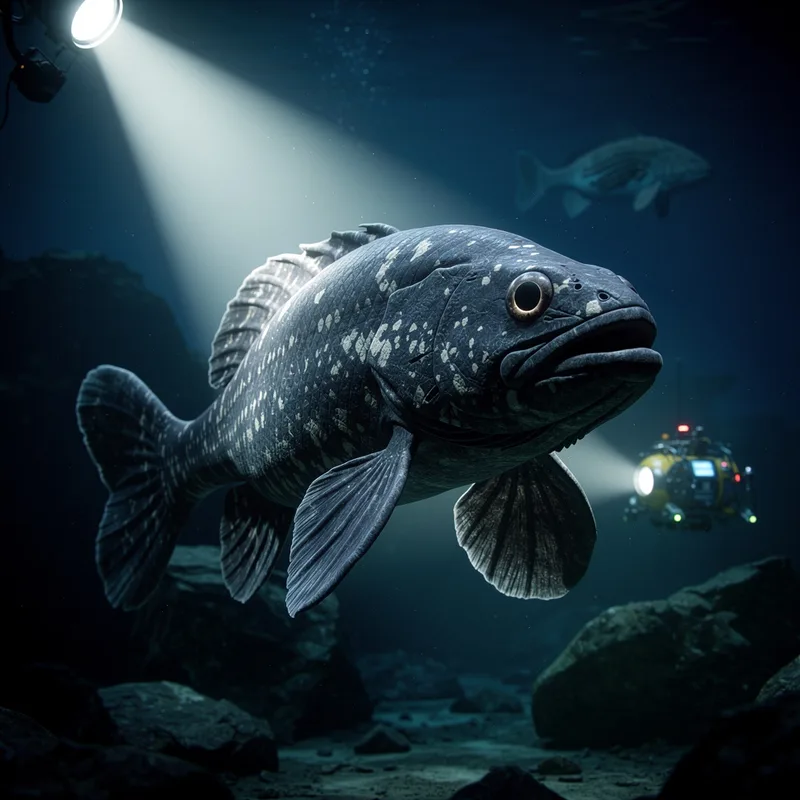
coelacanth
 1
9.9

- noun
- /ˈsiːləˌkænθ/
- In the deep sea, the coelacanth is a fascinating species that carries a rich evolutionary history dating back to the time of the dinosaurs.
Examples
-
Scientists are excited about the coelacanth, as it reveals important information about the evolution of fish and their development.
-
In particular, both people and coelacanths possess a visual pigment called rhodopsin, which enables them to see in dim light.
Academic text (2006) -
The coelacanth holds a special place in natural history.
Academic text (2006) -
Furthermore, science lost the first live coelacanth discovered in recent times.
Academic text (1993) -
Coelacanths have lived in the oceans for hundreds of millions of years and provide a window into the lives of other creatures.
Academic text (2006) -
The coelacanth carries its own extinct genes, which offer good examples of why and how genes become fossilized.
Academic text (2006) -
And in the decades since the discovery, many more coelacanths have been dredged up from their deep-sea habitats, including a second species discovered near Indonesia in 1998.
Academic text (2006) -
The coelacanth is a rare fish that was believed to be extinct for millions of years until it was rediscovered in 1938 off the coast of Africa.
Synonyms

 1
9.9
A rare deep-sea fish that people call a living fossil
 1
9.9
A living ancient fish thought extinct until its 1938 discovery off Africa
Surface Forms
Etymology
The word coelacanth comes from the Greek roots koilos 'hollow' and akantha 'spine', and it refers to the fish's hollow spines on its lobe-like fins. So the name fits this rare, ancient deep-sea fish that scientists once thought was extinct.