

coach house
- noun
- /koʊtʃ haʊs/
- UK
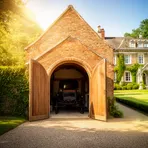
- The family stored their vintage car in the coach house next to the main estate.
Examples
-
Furtive steps came down the yard again, and Daft Jimmy peeped into the coach house.
Fiction book (1995) -
Once more he returned to the coach house.
Fiction book (1995) -
The tense rope swung him by his neck halfway across the coach house.
Fiction book (1995) -
One flattened the neighbor's coach house; blood dripped from baby Victor's left ear.
Fiction book (1995) -
After the horse-drawn carriage was cleaned, it was placed back in the coach house for the night.
-
She discovered old tools and dusty furniture hidden in the coach house behind the main house.
Synonyms
 7
6.8
7
6.8

A small building beside an old house where people keep carriages or cars

A small building where horse-drawn carriages are kept
How Big

Surface Forms
Morphology
The meaning is partly inferable from 'coach' (a carriage) + 'house' — a learner will plausibly guess the phrase refers to a building associated with coaches (e.g., storage/garage for carriages). However the common modern sense as a small self-contained dwelling or converted outbuilding is a metonymic/functional extension and not fully predictable from the literal parts (and 'coach' as 'carriage' is somewhat archaic), so B1 learners who only know the constituents may not derive the residential meaning reliably.
Etymology
Coach house was originally the small building beside a big house where the family's horse-drawn coach and horses were kept. So the image of a 'house for coaches' explains why it means 'a building used to store carriages or vehicles' today.