
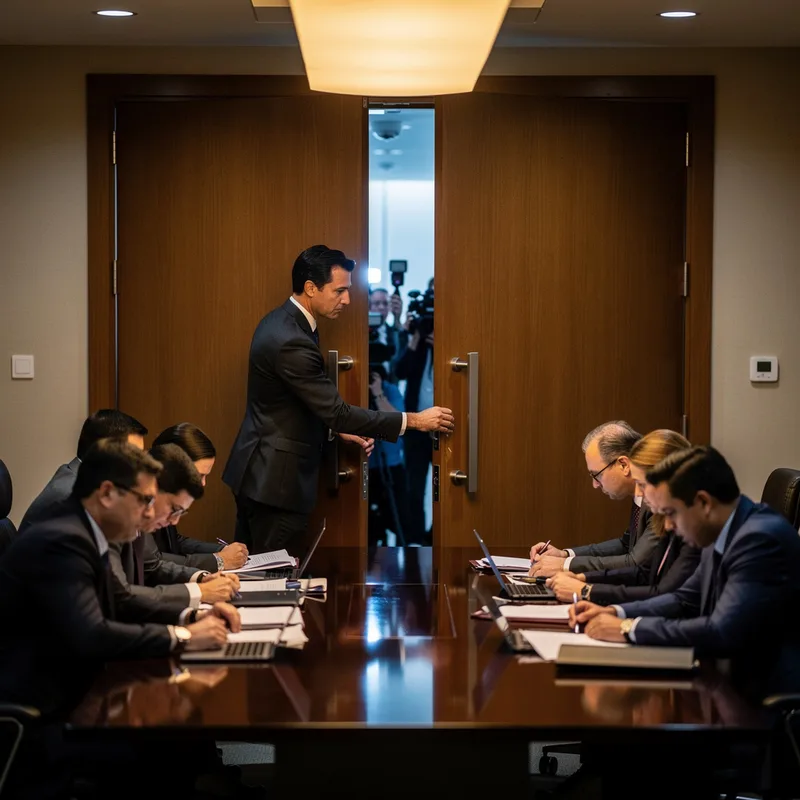
closed session
 8
5.5
8
5.5

- noun
- /kloʊzd ˈsɛʃən/
- Formal
- The board decided to conduct the financial review in a closed session to protect proprietary information.
Examples
-
During the closed session, the legislators reviewed confidential reports that could impact national security.
-
The attendees milled around in the hallway as the closed-session meeting took place, from 6:30 to 7:21 p.m., when they were allowed back in.
Blog text (5) -
The board would not be allowed to talk about the candidates or interview them in closed session.
Blog text (11) -
The Brown Act allows closed sessions under the scope of a regular meeting.
Blog text (16) -
If they make any decisions, they have to disclose those in public after their closed session meeting.
Blog text (5) -
The board entered into a half-hour closed session to discuss threatened litigation against the county.
Blog text (31) -
Following a closed session, Lore said that since litigation has been settled, they can provide updates on Memphis.
Blog text (17) -
Under New York law, elected bodies can—but are not required to—go into closed session to discuss personnel matters.
Blog text (29) -
The council held a closed session to discuss sensitive matters away from the public eye.
Synonyms
 4
7.6
4
7.6
A private meeting of a board or committee to discuss confidential matters

A private meeting where people make important decisions away from the public
How Open

Surface Forms
Morphology
The meaning 'a meeting not open to the public' is directly and transparently derived from 'closed' (not open) modifying 'session' (a meeting). This simple adjective+noun composition follows regular English semantics and is cross-linguistically common, so a B1 learner who knows both constituents will readily infer the MWE meaning.
Etymology
Closed session comes from the simple image of a meeting room with the door shut: closed (shut) and session (a meeting). When people shut the door so others cannot enter or listen, the meeting is 'private', so today closed session means a meeting not open to the public.