
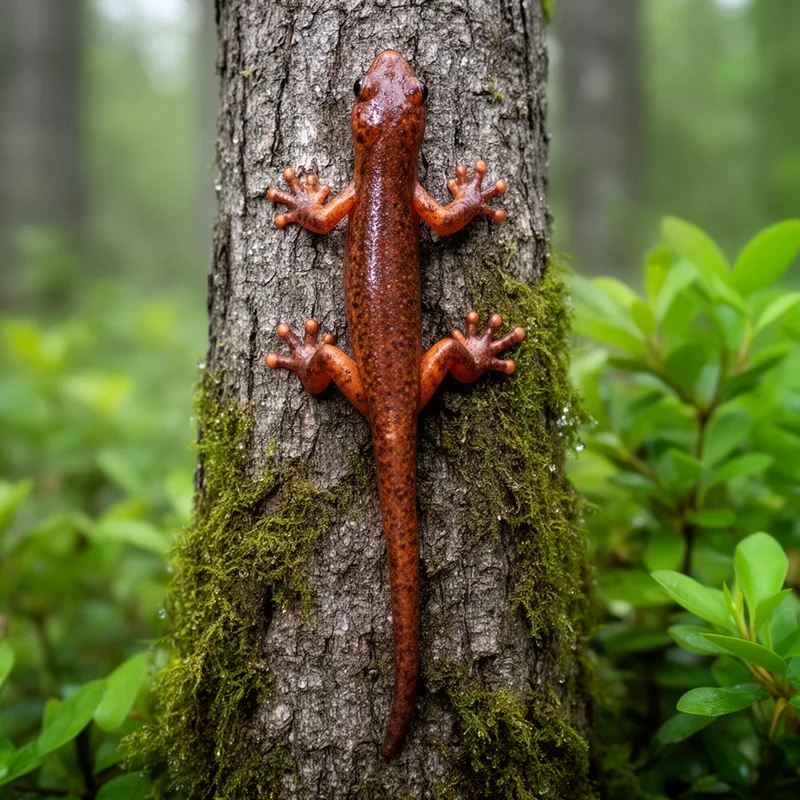
climbing salamander
- noun
- /ˈklaɪmɪŋ ˈsæləmændər/
- US
- The climbing salamander has specialized toes that help it cling to tree bark.
Examples
-
Researchers found a climbing salamander resting on a moss-covered branch after it had rained.
-
Unlike other amphibians, the climbing salamander spends much of its time off the ground in shrubs and trees.
-
The climbing salamander is known for its unique adaptations.
-
Have you ever seen a climbing salamander in the wild?
-
Researchers found a climbing salamander resting on a moss-covered branch after it had rained.
-
The climbing salamander has specialized toes that help it cling to tree bark.
-
Unlike other amphibians, the climbing salamander spends much of its time off the ground in shrubs and trees.
Synonyms
 12
4.9
12
4.9

A small animal like a lizard with a long tail that lives on land and returns to water to breed

A small climbing salamander with sticky toe pads that lives in North and Central America

A small brown animal like a lizard with yellow spots that climbs trees at night in California forests
A small water-and-land animal with webbed toes and a long tongue used to catch insects and climb smooth rocks
A group of salamanders with webbed toes that climb and catch prey with a long fast tongue
Surface Forms
Morphology
The compound is directly compositional: 'climbing' (moving upward/able to climb) + 'salamander' (an amphibian) yields a salamander that climbs or is adapted for climbing. This participle+noun pattern is a common, predictable descriptive construction in English and other languages, so a B1 learner who knows the constituents can infer the meaning.
Etymology
Climbing salamander — The name climbing salamander comes from a simple picture: climbing shows the action and salamander is the animal. These salamanders have strong toes for holding branches and leaves, so the name means 'a salamander that climbs'.