
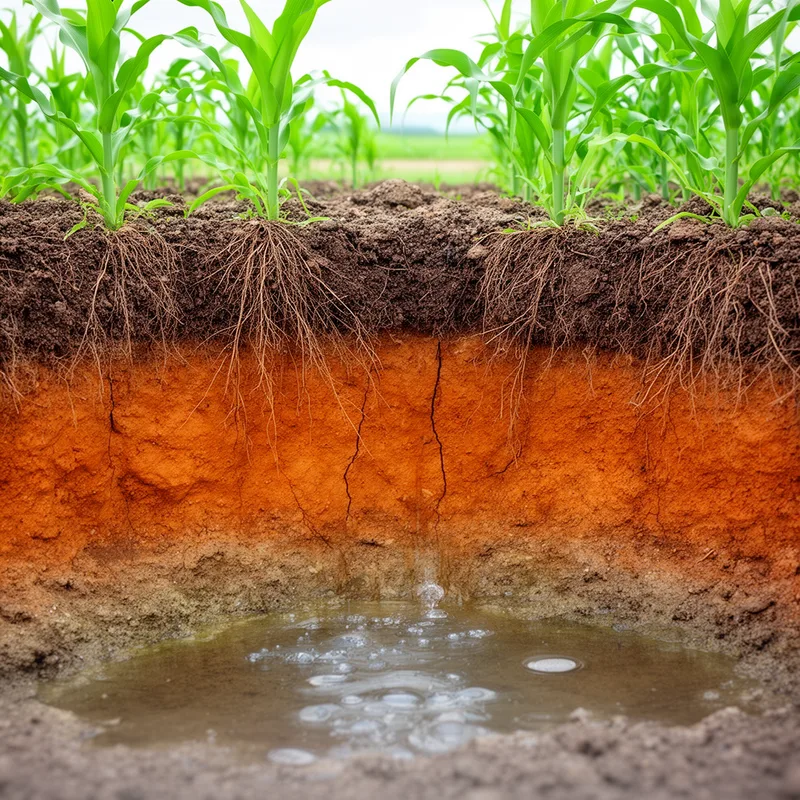
claypan
- noun
- /ˈkleɪˌpæn/
- Specialized
- Newell R. Kitchen, an ARS soil nitrogen management expert who works with Alberts, says, "A claypan layer restricts roots and lowers crop yields."
- claypan layer
- claypan soil
Examples
-
"Tillage machines can help break up the clay layer," says Alberts, "but the claypan quickly returns."
Academic text (1997) -
Hedges may also act as a safety net, helping to increase worm populations—especially in claypan soils where water runoff is often greater because the underlying pan layer is so impenetrable.
Academic text (1995) -
The claypan also causes surface runoff that has high herbicide levels.
Academic text (2000) -
The research focuses on the claypan soil region in north-central and northeastern Missouri.
Academic text (2000) -
To set variable rates for nitrogen, the Missouri scientists experimented with sensors for estimating claypan topsoil depth.
Academic text (2000) -
Iowa, to the ARS Cropping Systems and Water Quality Research Unit in Missouri to see if they could help break up a soil claypan layer that reduces crop yields by inhibiting root growth.
Academic text (1995) -
"Its roots grow well in soils with pH in the range of 4.2 to 5.0, which is common for claypans and other restrictive layers and is toxic to the roots of most crops," says Foy.
Academic text (1997) -
Farmers in the region struggle to grow crops due to the thick claypan, which restricts root growth.
-
The claypan layer underneath the fields prevents water from draining, leading to poor soil conditions.
-
In areas with a claypan, it is common for plants to fail due to limited access to water.
Synonyms
 1
9.4
1
9.4

A hard layer under the soil that stops roots and water
Antonyms

How Impermeable

Surface Forms
Morphology
Etymology
Claypan comes from the simple parts clay and pan; imagine a hard, flat 'pan' of clay just under the soil that 'does not let water through' or roots pass. That's why a claypan is a dense layer that stops water movement and root growth.