
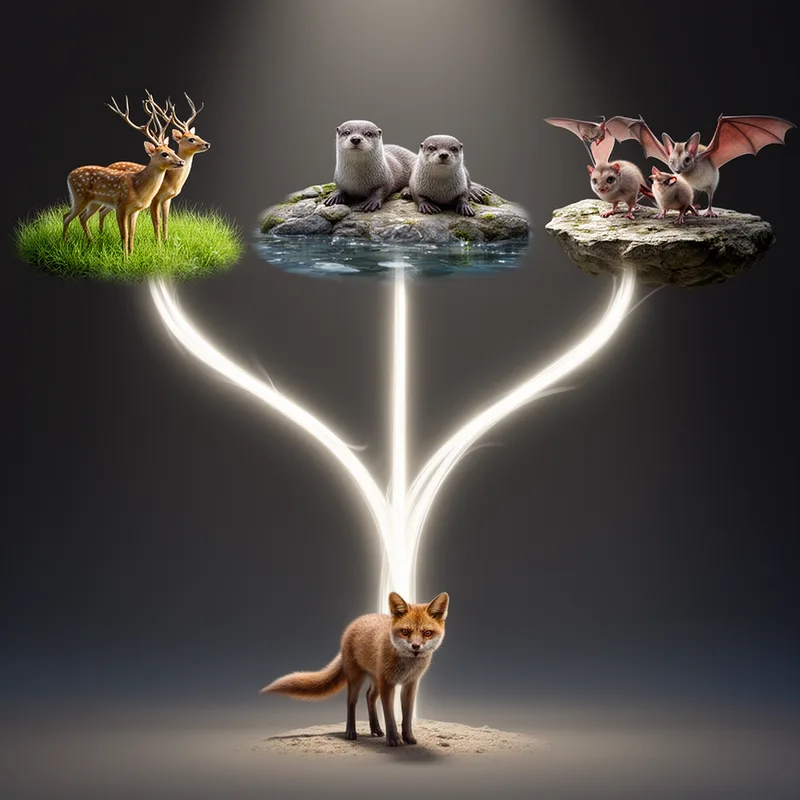
cladogenesis
- noun
- /ˌklædəˈdʒɛnɪsɪs/
- Specialized
- During the process of cladogenesis, one species can give rise to several new species over time.
- cladogenesis of language
Examples
-
Also, it is entirely possible in principle that most evolutionary change occurs within a single lineage (anagenesis) rather than via branching (cladogenesis).
Blog text (8) -
Note that language richness is generally the product of language-splitting events (cladogenesis), whereas phylogenetic diversity and disparity are produced by both anagenesis (change within lineages) and cladogenesis (figure 3).
Academic text (2013) -
Multiple variants of the same enzyme are produced by different alleles. Cladogenesis.
Academic text (2011) -
Mechanisms driving language cladogenesis.
Academic text (2013) -
In particular, we draw on previous empirical and theoretical work to outline the mechanisms that drive linguistic cladogenesis and disparity.
Academic text (2013) -
In the next section, we address this by discussing a series of potential mechanisms that are involved in language cladogenesis and in the formation of linguistic disparity.
Academic text (2013) -
Note that language richness is generally the product of language-splitting events (cladogenesis), whereas phylogenetic diversity and disparity are produced by both anagenesis (change within lineages) and cladogenesis (figure 3).
Academic text (2013) -
I fail to see where biological transmutation is any more far-fetched than panspermia, punctuated equilibrium (cladogenesis), or phyletic gradualism (anagenesis), etc.
Blog text (12) -
The theory of cladogenesis helps explain how diverse species evolve from a common ancestor.
-
Research on cladogenesis illustrates how environmental changes can lead to the formation of new lineages.
Synonyms
 4
8.3
4
8.3

A process by which new species form from existing ones
Surface Forms
Morphology
Etymology
The word cladogenesis comes from Greek roots klados 'branch' and genesis 'origin'. So, think of a family tree or a tree branch splitting: when one species divides into new 'branches' (new species), that is cladogenesis.