
circumpolar


 1
9.9
1
9.9
- adjective
- /ˌsɜrkəmˈpoʊlər/
- Specialized
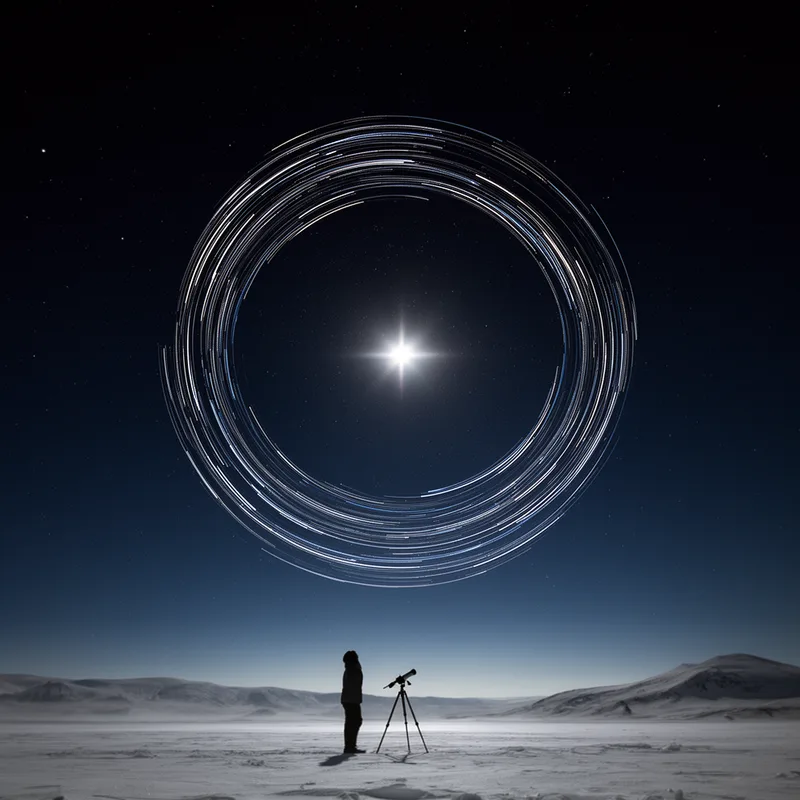
- Astronomers note that stars labeled as circumpolar are visible all year in the northern hemisphere, making them unique for night sky observations.
- circumpolar star
Examples
-
This circumpolar ring encompasses most of the second- and third-order stars of Cassiopeia, Cepheus, Draco, and Ursa Major.
Academic text (1995) -
They are known as circumpolar constellations.
Fiction book (1999) -
Cassiopeia is a what's called a circumpolar constellation, so it's closer to the North Star.
-
The star is a yellow sub-giant of 3rd magnitude (app.) located 45 light-years off, but unfortunately is also a northern circumpolar star.
Blog text (1) -
Emlen has demonstrated that buntings learn to identify the direction of the North Celestial Pole by studying circumpolar star patterns.
Academic text (1995) -
The successive German directors conducted various astrometric surveys, including precise determinations of positions of nebulae, double stars, and circumpolar stars.
Academic text (2005) -
Indigo buntings will be able to locate the celestial pole thousands of years from now, even though precession will have altered the circumpolar star patterns compared to the sky of today.
Academic text (1995) -
In regions close to the North Pole, certain stars are classified as circumpolar because they never set below the horizon.
-
At higher latitudes, many constellations are circumpolar, allowing stargazers to observe them all night long without interruption.
Surface Forms
Morphology
Etymology
Circumpolar comes from circum- 'around', like the English word 'circle', and polar 'pole'. Think of a star that moves 'around the pole' and never sets below the horizon, so it stays visible all night or all year from places far north or south.