
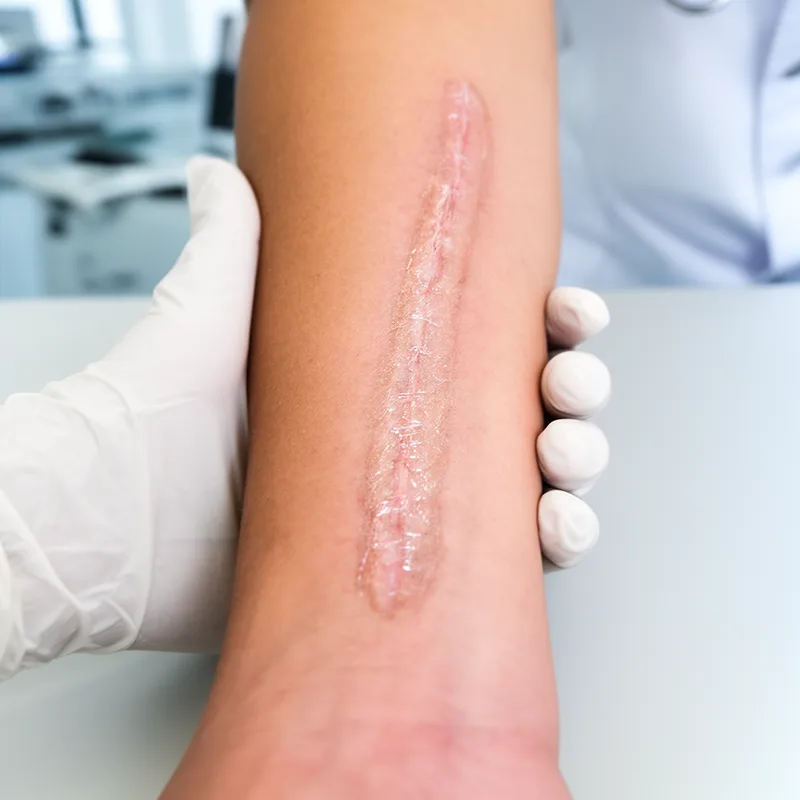
cicatricial


 1
9.9
- adjective
- /ˌsɪkəˈtrɪʃəl/
- Specialized
- The surgeon explained that cicatricial tissue forms as the wound heals, leaving a scar.
- cicatricial alopecia
- cicatricial ectropion
- cicatricial pemphigoid
Examples
-
Cicatricial alopecia secondary to burns, trauma, surgery, or radiotherapy is a distressing problem.
Academic text (2015) -
In the long term, there was no cicatricial ectropion or abnormal scarring on the face.
Academic text (2015) -
From January 2005 to December 2010, 37 patients with cicatricial alopecia were consecutively admitted for treatment.
Academic text (2015) -
In the current report, we present our experience with treating secondary cicatricial alopecia using FUT.
Academic text (2015) -
In general, even higher FU densities are not recommended in areas of cicatricial alopecia.
Academic text (2015) -
CONCLUSION: Follicular unit transplantation is an effective method for treating cicatricial alopecia.
Academic text (2015) -
In secondary cicatricial alopecia, the follicle is an 'innocent bystander' and is not specifically destroyed.
Academic text (2015) -
Finally, using a donor source of only head-derived hair may not adequately serve the needs of severe cicatricial alopecia patients.
Academic text (2015) -
Traditional surgical treatments for secondary cicatricial alopecia include excision, scar reduction, tissue expansion, and scalp flap.
Academic text (2015) -
Our investigation demonstrated that FUT is a good method for treating cicatricial alopecia with several advantages, including minimal invasiveness, relative safety, high transplantation density, and satisfactory postoperative results.
Academic text (2015)
Synonyms
 1
7.9
Having thick scar tissue that forms after injury or disease
Antonyms

How Scarred

Surface Forms
Morphology
Etymology
Cicatricial comes from the Latin word cicatrix, which means 'scar'. So cicatricial describes tissue or changes that are 'scar-like' after a wound heals.