

chthonic
 1
9.9
1
9.9

- adjective
- /ˈθɒnɪk/
- Literature
- Observing that certain middle Byzantine vessels represent serpents, animals commonly associated with demons, Henry Maguire proposes that the motif of the snake may invoke chthonic powers.
- chthonic forces
Examples
-
Taking this act of touching the earth with the mpoko one step further, I read this performance as a chthonic gesture—the word "chthonic," from the Greek word for "earth," relating to some kind of underworld or spirit world.
Academic text (2006) -
The chthonic monsters.
-
The chthonic forces are here at work.
Academic text (1995) -
The chthonic spirits have it in for my family.
Fiction book (1992) -
Your neck of the woods is rife with nodes of chthonic power, Telemachus.
Fiction book (1994) -
A truly chthonic rapport with the Earth is infinitely more likely to be had among newts than among humans.
Academic text (2016) -
Soyinka explicitly identifies the music with chthonic forces; it came from "somewhere deep down in the earth, from crushed soil" (111).
Academic text (2008) -
From that moment on, the chthonic beings could no longer steal material things, only spiritual ones—namely the souls of the Teeneks.
Academic text (2008) -
The moon itself is said to be "the eye of Kibawa" (Kalunga Mwela-Ubi, pers. com., 1986), the great chthonic spirit to be discussed shortly.
Academic text (1990) -
In ancient mythology, chthonic deities were believed to rule over the underworld.
Synonyms
 9
8.2
9
8.2
Below something else in a lower position
 1
9.9
1
9.9
So dark and frightening that it feels like a deep underground place

Relating to the underworld or things under the earth

Relating to the world of the dead in Greek myth

Relating to the underworld of old stories or to the earliest time in Earth's history
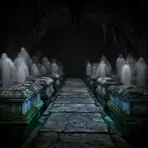
Dark and gloomy like a place where dead people live

Very dark and gloomy like a place of the dead
How Deep

Surface Forms
Etymology
The word chthonic comes from the Greek root khthon meaning 'earth' and was used for gods or spirits who lived under the ground. So chthonic now describes things or beings of the underworld or that are beneath the earth.