
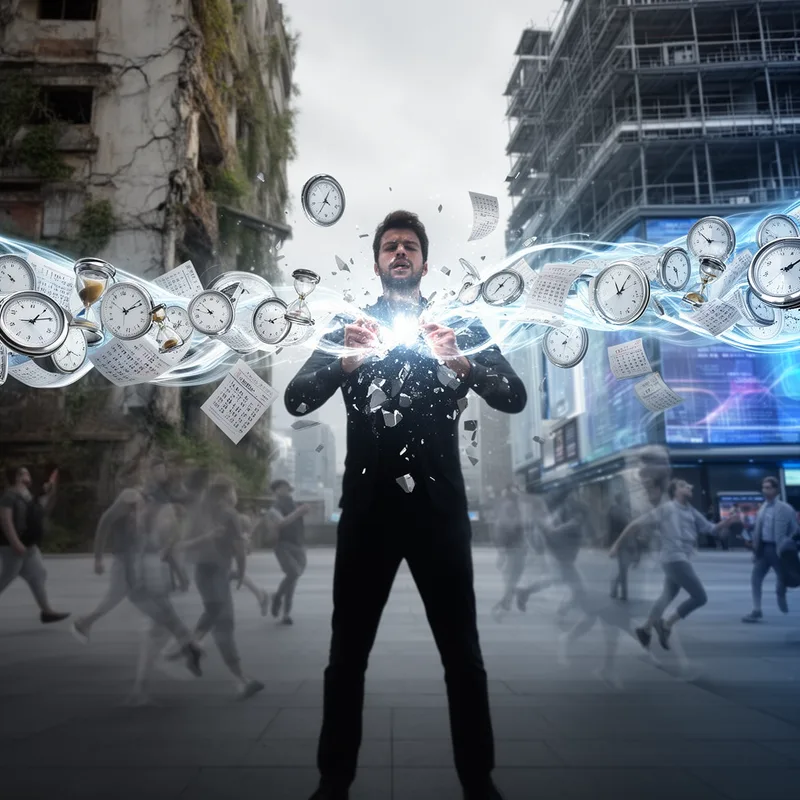
chronocidal act
- noun
- /ˌkrɒnəˈsaɪdəl ækt/
- Literature
- The villain's chronocidal act caused years of history to unravel instantly.
Examples
-
Scientists theorized that a chronocidal act could have devastating effects on the universe.
-
Every chronocidal act in fiction raises questions about fate and free will.
-
A chronocidal act can unravel time!
-
The villain committed a chronocidal act that altered history.
-
The villain's chronocidal act caused years of history to unravel instantly.
-
Scientist theorized that a chronocidal act could have devastating effects on the universe.
-
Every chronocidal act in fiction raises questions about fate and free will.
How Disruptive


Surface Forms
Morphology
chronocidal + act
The headword 'chronocidal' is a rare, derived formation from Greek roots (chrono- 'time' + -cidal 'killing/ destroying') rather than a familiar everyday English word; B1 learners generally do not know these affixes or recognize this coinage. Knowing only the common constituent 'act' would not allow a learner to infer the specialized sci‑fi meaning, so the phrase is not predictably compositional for typical learners.
Etymology
Chronocidal act may come from the parts chrono, meaning 'time', and -cidal, meaning 'to kill'. Picture someone smashing a clock or tearing a calendar so time seems to stop; that image shows why the phrase means an act that breaks or destroys the normal flow of time.