
chromosphere
 1
9.8

- noun
- /ˈkroʊməˌsfɪr/
- Specialized
- Through specialized telescopes, we can observe the dynamic features of the Sun's chromosphere, including solar flares.
- the chromosphere of the sun
Examples
-
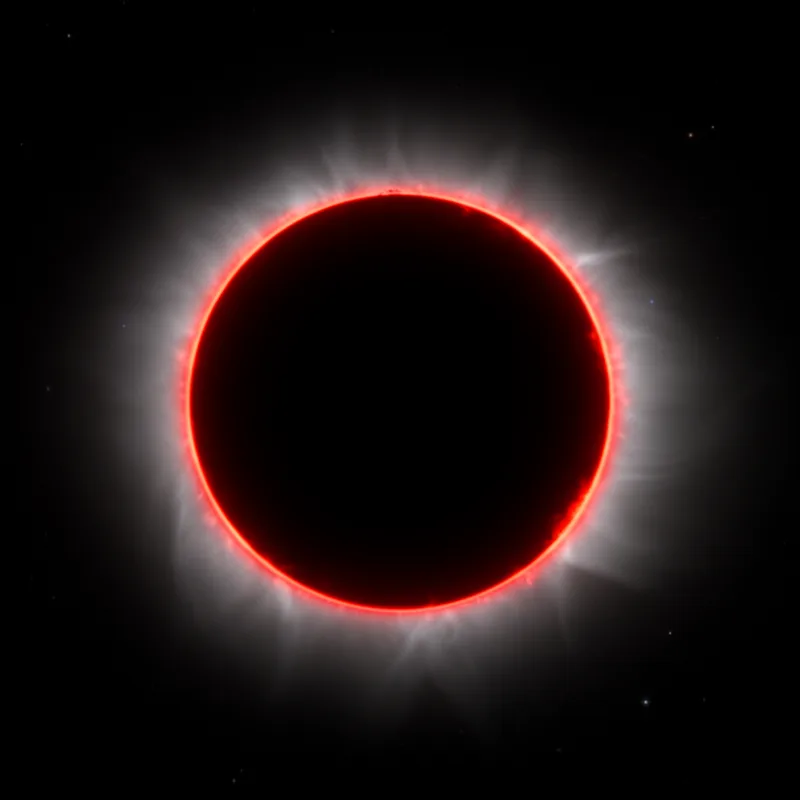
During total solar eclipses, when first the photosphere and then the chromosphere are completely hidden from view, a faint white halo around the Sun becomes visible.
Academic text (1991) -
Thus, by studying the solar chromosphere, we are also learning what the chromospheres of other stars are like.
Academic text (1991) -
Under high resolution, we see that the chromosphere is not a spherical shell around the Sun but rather is composed of small spikes called spicules.
Academic text (1991) -
Helium was added shortly afterward when it was discovered via emission line spectra of the Sun's chromosphere.
Academic text (2005) -
This layer glows a colorful pinkish hue when seen at an eclipse, and is thus called the chromosphere (from the Greek chromos, color).
Academic text (1991) -
Since the chromosphere during an eclipse appears as hot gas silhouetted against a dark sky, the chromospheric spectrum consists of emission lines that appear to flash into view at the beginning and out of view at the end of totality; so the visible spectrum of the chromosphere is known as the flash spectrum.
Academic text (1991) -
During a total solar eclipse, the reddish glow of the chromosphere can be seen around the edge of the Moon.
-
Astronomers often study the chromosphere to understand the sun's magnetic activity and its effects on space weather.
Surface Forms
Morphology
chromosphere = sphere (semi-transparent) = chromo + sphere
Built from the combining form 'chromo-' (colour) and 'sphere' (region), but the specialized astronomical meaning ('a layer of the sun') is not directly inferable by most learners.
Etymology
Chromosphere comes from the Greek parts chroma 'color' and sphere 'ball', and you can see chroma in words like chrome and chromatic. It names the sun's thin colored layer that appears as a red ring during a total eclipse, so the word points to the sun's 'color' layer.