
chromolithograph


 1
9.9
- noun
- /ˌkroʊməˈlɪθəˌgræf/
- Specialized
- The masquerade, snakes and all, is derived directly from the snake-charmer chromolithograph discussed above.
- chromolithograph of a snake
- chromolithograph of the snake-charmer
- a popular chromolithograph
Examples
-
Detail and wide view of a sequined, framed chromolithograph hanging in an Ethiopian Orthodox papal library.
Academic text (2009) -
The final work retains elements of its chromolithograph base in the poses of the figures and their features.
Academic text (2009) -
What does this mean when a chromolithograph is turned from a mass-produced image back into a painting?
Academic text (2009) -
Ultimately, for Ethiopian Orthodox practitioners, a chromolithograph can have just as much spiritual value as a hand-painted image.
Academic text (2009) -
I believe that this practice serves to reinforce the chromolithograph's increasing value within the Ethiopian Orthodox religious community.
Academic text (2009) -
The Indian chromolithograph shows Shiva as an ascetic in deep meditation atop the Himalayas.
Academic text (1999) -
Devotees believe the chromolithograph to be of a Fulani hunter meeting with Tchamba in the desert (Fig. 22).
Academic text (1999) -
Ezili is most commonly saluted in the chromolithograph of the Mater Dolorosa (Fig. 7).
Academic text (1996) -
Right: 17. Chromolithograph of Shiva. Purchased in Lomé, Togo, May 1995. Photo: Dana Rush.
Academic text (1999) -
The Indian chromolithograph shows Shiva as an ascetic in deep meditation atop the Himalayas.
Surface Forms
Morphology
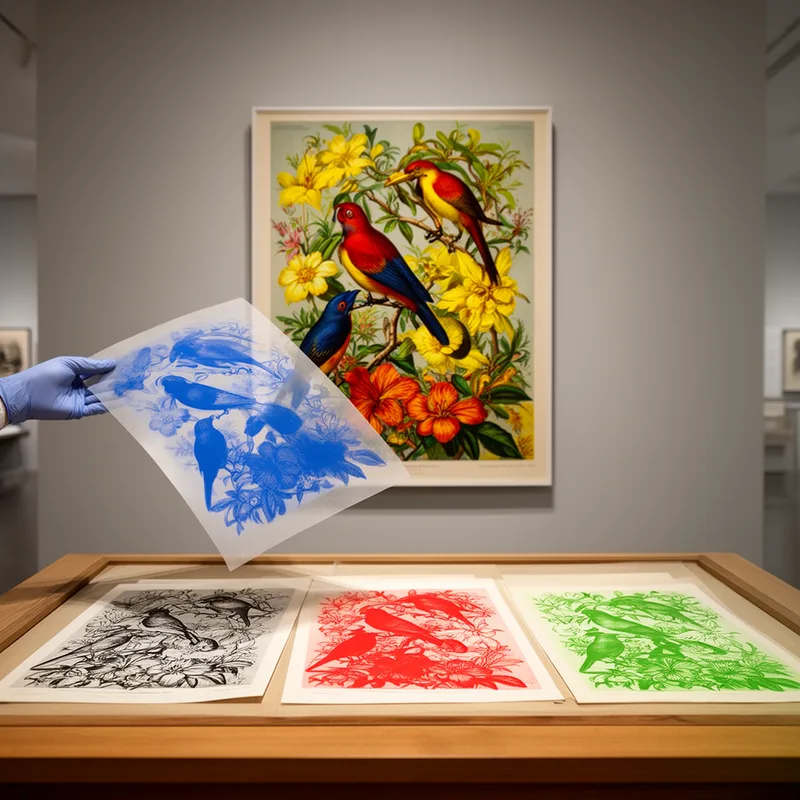
chromolithograph = lithograph (semi-transparent) = chromo + lithograph
The base 'lithograph' clearly indicates the kind of print, but 'chromo-' is a technical combining form meaning 'color' that may be unfamiliar to average B1 learners.
Etymology
Chromolithograph comes from three parts: chromo- meaning 'color', -litho- meaning 'stone', and -graph meaning 'to write or print'. So a chromolithograph is a 'color stone print', which explains why the process prints each color in separate layers using stone plates.