

choroid
- noun
- /ˈkɔːrɔɪd/
- Specialized
- The choroid contains pigment that helps prevent excess light from scattering within the eye.
Examples
-
The choroid is the layer of the eye that nourishes the retina with its numerous blood vessels.
-
The histopathological abnormalities thus seem to represent the spectrum of a limited set of responses that the posterior retina/choroid can mount during an immunodestructive event.
Academic text (1991) -
Damage to the choroid can lead to vision problems due to its role in providing essential nutrients to the eye.
Synonyms
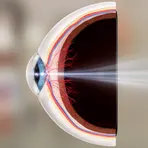
A dark layer with many blood vessels between the retina and the white of the eye that stops light scattering
Compounds
- Specialized
A dark layer with many blood vessels between the retina and the white of the eye that stops light scattering

- Specialized
A network of blood vessels in brain cavities that makes the clear fluid around the brain and spinal cord

- Specialized
A blood vessel in the eye that carries blood away from the choroid layer
Surface Forms
Morphology
choroid = chorion (opaque) = chorio + oid
The combining element 'chorio-' and the related word 'chorion' are specialised medical terms unfamiliar to average learners, so the meaning is not transparently derivable.
Etymology
Choroid comes from the Greek root chorion meaning 'membrane' and the ending -oid meaning 'like'. So, the choroid is the 'membrane-like' layer full of blood vessels and dark pigment that sits between the retina and the white of the eye and helps feed and protect the retina.

