
chlorhexidine


 1
8.7
1
8.7
- noun
- /klɔrˈhɛksɪdiːn/
- Specialized
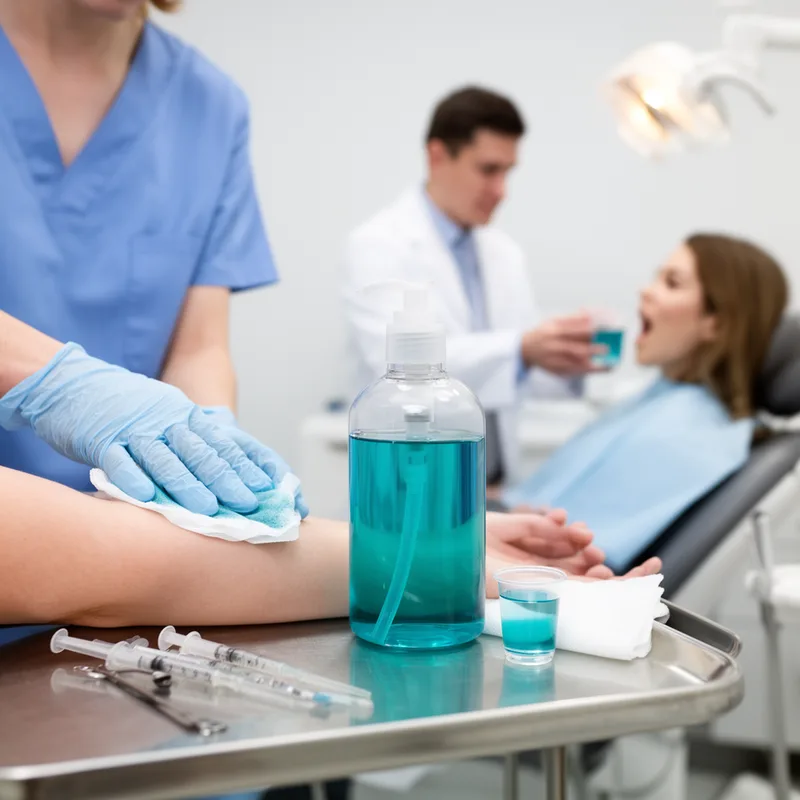
- Chlorhexidine is commonly used to disinfect the skin before surgery.
Examples
-
This treatment may be combined with the use of systemic antibiotics and home use of chlorhexidine mouth rinses.
Academic text (2000) -
For skin disinfection before the insertion of an IV catheter, 2% alcoholic chlorhexidine is more effective than 10% povidone-iodine in the prevention of catheter-related infections.
Blog text (25) -
Chlorhexidine solution was applied to the skin.
Academic text (2003) -
Disinfectants, such as chlorhexidine, are extensively used in hospitals and other health-care settings.
Academic text (2018) -
Once the tick has been removed, the area should be washed with a disinfectant such as chlorhexidine or cleaned with an alcohol skin wipe.
Academic text (2014) -
The addition of chlorhexidine to alcohol is known to intensify its bactericidal effects (Elston, 2007).
Academic text (2010) -
Chlorhexidine, which is an antiseptic that is effective against Gram-negative and Gram-positive bacteria, disrupts cell membranes.
Academic text (2018) -
The excision area was disinfected with 2% chlorhexidine lotion and marked according to the required size of the donor strip (Figure 2A).
Academic text (2015) -
Use of cleansing solutions included normal saline (70%), povidone-iodine (12%), chlorhexidine (12%), surgical spirits (alcohol; 6%), and hydrogen peroxide (6%).
Academic text (2005) -
Health care professionals recommend using chlorhexidine to prevent infections during procedures.
Antonyms

Surface Forms
Morphology
chlorhexidine = chloro + hexidine
The term is built from technical chemical combining forms (e.g., 'chloro-' + 'hexidine') that are not productive standalone English words, so learners cannot reliably infer the medical meaning from the parts.
Etymology
Chlorhexidine combines two chemical parts: chlor- meaning 'green' (as in chlorine or chlorophyll) and hex- meaning 'six' (as in hexagon). A helpful way to remember it is to think of the name as describing the chemical parts that make this long-lasting antiseptic, so chlorhexidine is the disinfectant used on skin and in the mouth.