

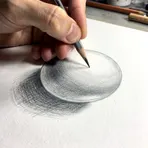
chiaroscuro technique
- noun
- /ˌkiːəroʊˈskjʊəroʊ/
- Specialized
- The artist's chiaroscuro technique dramatically highlights the expressions on her subjects' faces.
Examples
-
Using chiaroscuro technique, Caravaggio gave his work a remarkable sense of depth.
-
Many contemporary photographers adapt the chiaroscuro technique to achieve mood and drama in portraits.
-
The artist used a chiaroscuro technique to enhance the depth of her painting.
-
Many Renaissance painters mastered the chiaroscuro technique.
-
The artist mastered the chiaroscuro technique to give depth to his portraits.
-
Using the chiaroscuro technique, she added dramatic shadows to her landscape painting.
-
He explained how the chiaroscuro technique enhances the three-dimensionality of figures in art.
Synonyms
 11
3.1
11
3.1

Marks made in a drawing to show light and shadow and make it look three-dimensional
 3
9.9
3
9.9
A strong contrast between light and dark in paintings or photos that shows depth
 1
6.4
1
6.4
A drawing method using crossed lines to make shading and texture
Antonyms


How Contrastive

Surface Forms
Morphology
The phrase is directly compositional: 'chiaroscuro' names the specific light–dark painting method and 'technique' means a method, so 'chiaroscuro technique' simply refers to a method using chiaroscuro. This is a common style+technique noun combination and would be immediately understandable to a B1 learner who knows both constituent words.
Etymology
Chiaroscuro technique comes from the Italian word chiaroscuro, which means 'light' and 'dark'. Painters would put bright light on a subject and leave the rest in deep shadow to make shapes look solid and dramatic, so the phrase now means a way of using strong contrasts between 'light' and 'dark'.