
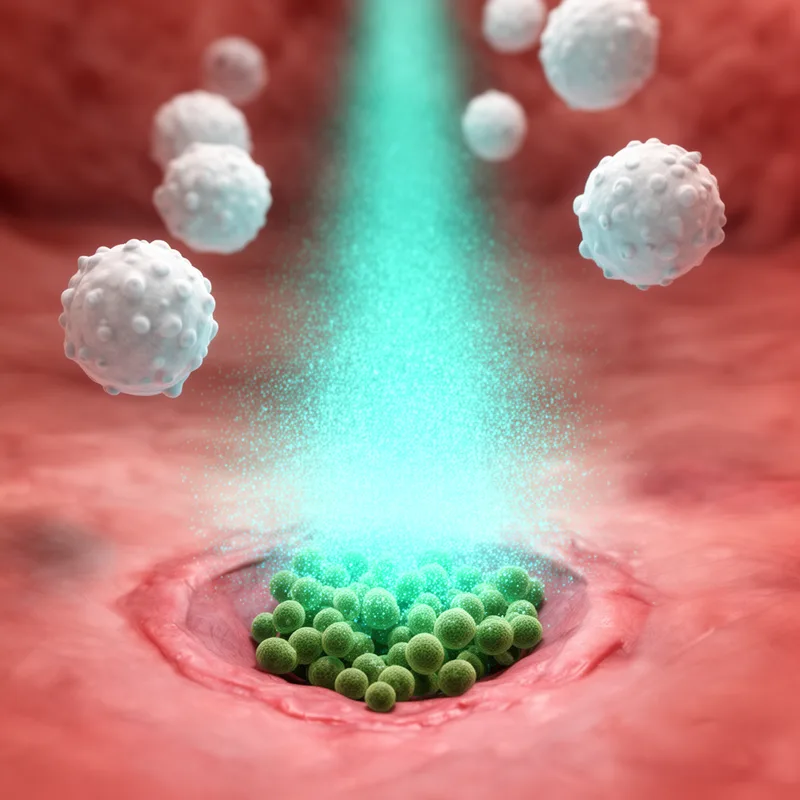
chemoattractant


 1
9.9
- noun
- /ˌkiːmoʊəˈtræktənt/
- Specialized
- In the simple LEGI model we have been discussing, the ratio of the response between the front and the back of the Dictyostelium cell is no greater than the ratio of the concentration of the external chemoattractant.
- chemoattractant concentration
Examples
-
Bacterial cells move toward the chemoattractant in their environment to find nutrients.
-
The presence of a chemoattractant generates extended movement in the favorable direction, such that the population as a whole moves toward the attractant.
Academic text (2012) -
Bacterial cells swimming through an environment containing a chemoattractant experience noise both from within themselves and from the environment.
Academic text (2012) -
Since the chemoattractant is present in this environment, external (or environmental) noise inevitably has an impact on ligand binding dynamics.
Academic text (2012) -
Since that stochastic behavior occurs even for large gradients, it is not caused by noise (discussed above) associated with chemoattractant sensing.
Academic text (2012) -
Whereas intracellular noise is present even without a chemical stimulus, the presence of a chemoattractant introduces an additional source of noise through the binding of the chemical ligand to the chemoreceptors.
Academic text (2012) -
In many real situations, the chemoattractant in the extracellular environment is not static; it is also subject to fluctuations (Patnaik 2006a, 2007; Xu and Tao 2006).
Academic text (2012) -
In addition, the chemoattractant ligand concentration itself fluctuates, as studied in the seminal work of Howard Berg and Edward Purcell on chemosensing in bacteria and as extended by others.
Academic text (2012) -
One such example would be targeting the phenylacetic acid (PAA) catabolic pathway with selective inhibitors, as PAA functions as a potent chemoattractant for neutrophils.
Academic text (2018) -
The phagocyte will be attracted to the chemoattractant released by the pathogen.
Surface Forms
Morphology
chemoattractant = attractant (semi-transparent) = chemo + attract + ant
The meaning 'chemical' + 'attractant' is logically compositional, but 'chemo-' is a technical combining form and the full term is specialized biomedical vocabulary.
Etymology
Chemoattractant is made of chemo- meaning 'chemical', as in chemistry, and attractant meaning 'something that pulls', like a tractor that pulls things. So, a chemoattractant is a chemical that 'pulls' or guides cells to move toward it.