
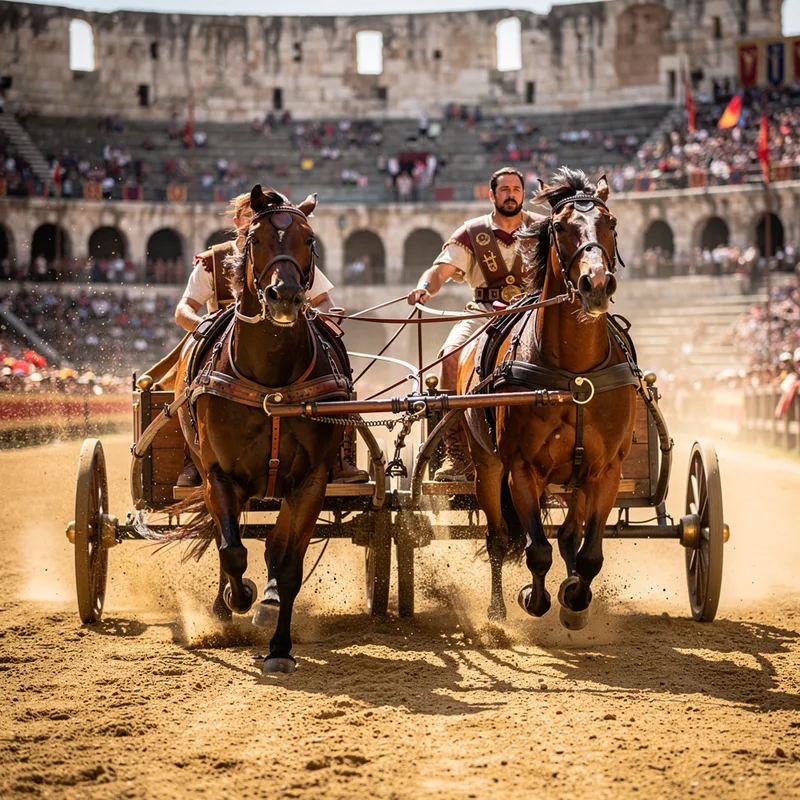
chariot race
 2
8.8
2
8.8

- noun
- /ˈʧɛriət reɪs/
- During the festival, citizens would gather to celebrate and enjoy the thrilling chariot races.
Examples
-
The reason to see Ben-Hur is for the chariot race.
Blog text (10) -
Drawings found in Thracian tombs 30 miles away depict chariot races, which used a smaller, sleeker kind of vehicle, during the fourth and fifth centuries B.C.
Academic text (2007) -
Get ready for the chariot race, kids.
-
The chariot race is coming up, kid.
-
Let's go downtown and watch the chariot races.
Fiction book (2001) -
Events ranged from simple horse racing to two and four horse chariot races to mule cart racing.
-
And of course, the chariot races in Constantinople were supposed to be a step forward from the excesses of the gladiators' arena in Rome.
Blog text (5) -
The city was also famous for its horses, and the poet Pindar praised Arkesilaos, "king of Cyrene with its fine horses," for his victory in a chariot race in 462 B.C.
Academic text (2005) -
The ancient stadium was filled with excited spectators eager to watch the chariot race.
-
In ancient Rome, a victorious driver in a chariot race was celebrated like a modern sports champion.
Synonyms
 ∞
1.0
∞
1.0
A contest to see who is fastest or finishes first
 23
1.6
23
1.6
An event where people ride or drive horses to see which is fastest

A horse race where a driver rides a small two-wheeled cart pulled by horses that trot or pace
Surface Forms
Morphology
The meaning 'a race between chariots' is directly and compositionally derived from 'chariot' (an ancient horse-drawn vehicle) + 'race' (a contest to see who finishes first), so a B1 learner who knows both words will readily infer it refers to a race using chariots. This noun+noun construction is a common, cross-linguistic compositional pattern and does not require idiomatic knowledge.
Etymology
Chariot race comes from a simple, visible picture: small wooden carts called chariots were pulled by fast horses while drivers tried to pass each other on a dusty track. These dangerous, exciting contests were a popular 'sport' in ancient Greece and Rome, so today chariot race means 'a race between horse-drawn chariots'.