

cerebrum
 4
6.7
4
6.7

- noun
- /səˈriːbrəm/
- Specialized
- The extent of differences in the proportion of the cerebrum in the different varieties of mankind is small, and with such slight gradational steps as to mark the unity of the human family in a striking manner.
Loading YouTube…
Watch on YouTubeComputationally, it's got much more going on than this from the cerebrum.
- Computationally, it's got much more going on than this from the cerebrum.
Examples
-
The memories deeply locked in the old man's cerebrum were being released in a rush to his consciousness.
Academic text (1991) -
The cerebrum is probably the first thing attacked.
Fiction book (2002) -
The cerebrum has suffered massive and irreparable damage.
-
The cerebrum has been completely severed from the mesencephalon.
-
The helmet's whole purpose is to interface the cerebrum, the seat of consciousness and rational thought, to the computer.
Fiction book (2002) -
Kingsley has compound frontal and parietal fracture and severe concussion of the cerebrum.
-
In the beginning, moist and infused with oxygen, the lush, gritty clay of his cerebrum had been good enough to eat, rich in salubrious minerals—food, indeed, for thought.
Fiction book (1990) -
The cerebrum is responsible for processing sensory information and controlling voluntary movements.
-
In humans, the cerebrum consists of two hemispheres that work together to enable complex thought.
-
Damage to the cerebrum can significantly affect a person's ability to think and reason clearly.
Synonyms
 ∞
1.0
∞
1.0
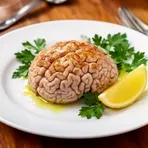
The soft part inside an animal's head that people eat as food
 3
7.5
3
7.5
The front part of the brain that controls thinking, memory, and planning


 1
9.9
1
9.9
Front part of the brain that holds the main thinking part and controls memory and movement

The part inside the skull that includes the brain and connects to the spinal cord
Surface Forms
Etymology
Cerebrum comes from a Latin word that meant 'brain', so the name literally points to the brain's main part. Think of it as the 'big brain' that does thinking, movement, feeling and awareness, and remember it is the same root as cerebral ('related to the brain') and not cerebellum ('little brain').