
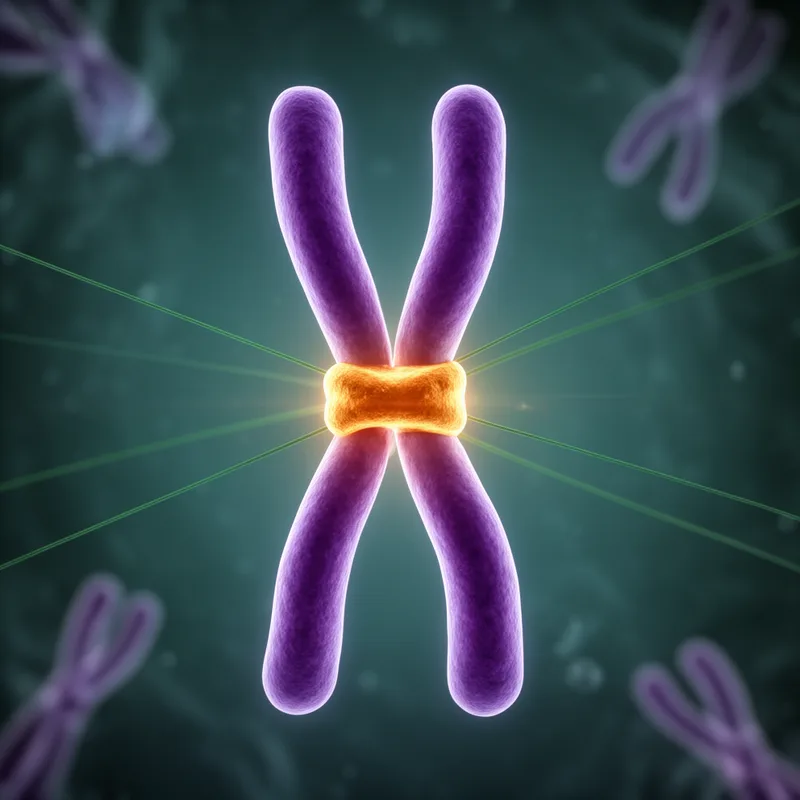
centromere
 1
9.7

- noun
- /ˈsɛntrəˌmɪr/
- Specialized
- The centromere is the region of a chromosome that connects two sister chromatids during cell division.
- centromere of chromosome
- centromere region
Examples
-
We also have much to learn about the intricacies of epigenetic factors on the centromere and on the placement of the kinetochore.
Academic text (2009) -
One particularly neat piece of evidence for fusion has to do with the centers of chromosomes, called centromeres.
Blog text (26) -
It's not just that there are telomeres and a centromere in the middle, but also the genes align almost perfectly.
Blog text (26) -
The centromere region is shown by virtue of binding to antibodies specific for kinetochore proteins.
Academic text (2009) -
Centromeres have a distinctive structure, and they play a crucial part in the replication of chromosomes.
Blog text (26) -
If human chromosome two had indeed evolved from the fusion of two older chromosomes, then it must have acquired two centromeres.
Blog text (26) -
Although the nucleation of the kinetochore at a chromosomal site is under epigenetic control, the underlying base sequence of the DNA at the centromere is not critical.
Academic text (2009) -
When we use the term "centromere," we mean the underlying base sequence at this site, and we are aware of the irony that this structure (by definition) cannot be seen in the light microscope (Earnshaw 1991).
Academic text (2009) -
Carbon and Clarke (1984) altered the nucleotide sequence of the DNA surrounding the centromere of yeast chromosome III and found that domains two and three are necessary for normal centromere function.
Academic text (2009) -
Scientists study the centromere to understand how chromosomes separate during the formation of new cells.
Surface Forms
Morphology
Etymology
The word centromere comes from Greek parts centro- meaning 'center' and -mere from meros meaning 'part'. So, a centromere is the central part that holds two sister chromatids together during cell division.