
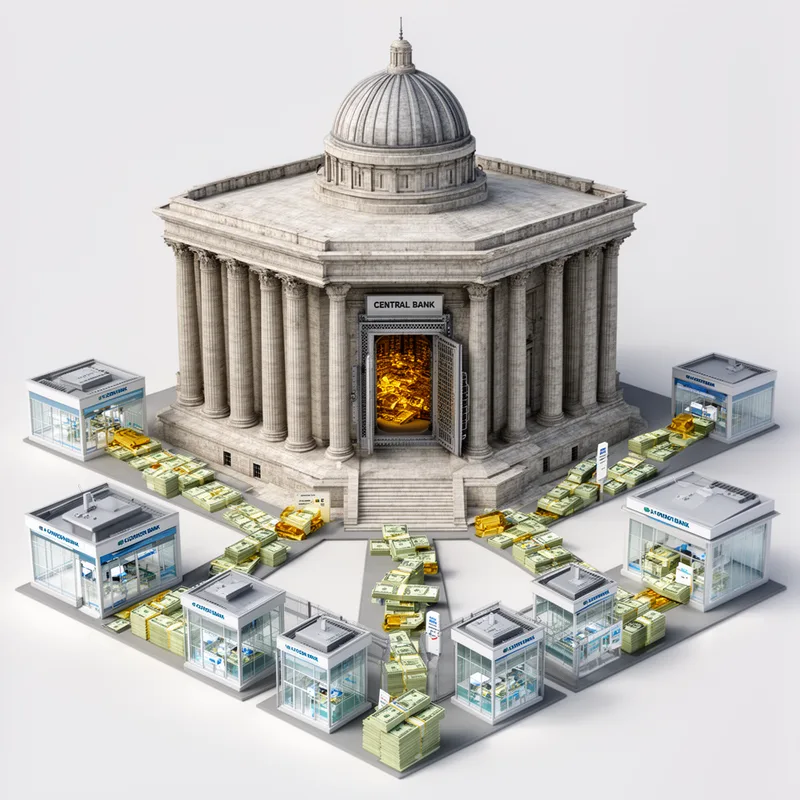
central bank
 100
3.1
100
3.1

- noun
- /ˈsɛntrəl bæŋk/
- The central bank regulates the country's monetary policy to ensure economic stability.
- central bank independence
- an independent central bank
- central bank monetary policy
Loading YouTube…
Watch on YouTubeSo the focus has been on how central banks generate inflation.
- So the focus has been on how central banks generate inflation.
- This is an issue for all central banks, not just for China.
- It's an independent central bank for the United States.
- So people ask that, well, without the central bank, what would happen?
- Only then could they apply to the central bank for approval for the transaction.
- The assets of Russia's central bank now face a more difficult question.
- And then there's talk about creating a central bank backed digital currency.
- So that drove the central bank to become the dominant institution of the world.
- Why then do we end up creating the central bank?
- that's new. In fact, you know, it's interesting. The one asset that central banks all own is gold.
- When you have a, a National Bank or a central bank that you're always going to have this problem.
- Which is first the central bank prints it, then the central bank lends it to government, then the government gives it out.
- But to summarise, ITAR money is a loan from the central bank and then that circulates throughout the economy.
- The new government quickly undermine the independence of the courts, the central bank and the media.
- In the wrong hands at the wrong time, a central bank can destroy a country by destroying the currency.
- My mom is not backed by the central bank to issue those loans.
Examples
-
The credit crunch got much worse in September, going far beyond what central banks and regulators could handle.
Academic text (2008) -
Politicians appear to expect the central bank to maintain low interest rates as well.
Academic text (1993) -
What problem may the central bank face in doing this?
-
This is an issue for all central banks, not just for China.
-
So people ask that, well, without the central bank, what would happen?
-
Why have faith in a central bank?
-
Several central banks were set up but then removed.
-
Only then could they apply to the central bank for approval for the transaction.
-
The economic impact of most concern to many governments and to central banks, in particular, is inflation.
Academic text (1990) -
The primary proponent of a central bank for the early United States was Alexander Hamilton.
How Central
100
3.1

- Specialized
12
3.0
Surface Forms
Morphology
The meaning 'the country's main bank' is directly and transparently derived from combining 'central' (main/most important) with 'bank' (financial institution). While detailed technical functions (monetary policy, interest rates) are specialized, the basic idea of a national or principal bank is compositional and cross-linguistically common, so a B1 learner who knows both words will grasp the MWE.
Etymology
The term central bank comes from the picture of one main bank at the central point of a country's money system, where the government and other banks go for help with money. That's why it means the country’s main bank that manages the money supply, helps other banks, and sets interest rates.