
cellular respiration
- noun
- /ˈsɛljələr ˌrɛspəˈreɪʃən/
- Specialized
- We developed a process and method of data analysis to help us address the misconceptions that undergraduate students exhibit in their explanations of the carbon cycle, photosynthesis, cellular respiration, and decomposition.
- cellular respiration process
Examples
-
For example, many college biology students do not recognize energy in a form that is not biologically useful (e.g., heat as a product of cellular respiration) and therefore misunderstand energy degradation (Hartley et al. 2011).
Academic text (2012) -
Although students spent considerable time on cellular respiration in Bio 2, many were unable to connect the process to decomposers in the spider monkey problem.
Academic text (2003) -
Once the CO2 is taken in by the plant, it is transformed into glucose and carbohydrates, as well as given off through cellular respiration.
Academic text (2003) -
Hypoxia initiates sequences of altered cellular respiration and energy pathways.
Academic text (2005) -
This model incorporates the importance of cellular respiration in proliferation and attributes high rates of lactate production to energetic excess, rather than energy deficiency.
Academic text (2016) -
Approximately 60 percent of the Bio 1/Bio 2 students accurately explained that cellular respiration is the process by which decomposers release carbon into the soil and atmosphere in response to the minke whale problem; 70 percent accurately described the same process in the Grandma Johnson problem.
Academic text (2003) -
Students who ignore or misunderstand matter conservation for gaseous reactants and products may not comprehend how cellular respiration results in a loss of carbon dioxide from organisms or that the atmosphere is the carbon source in photosynthesis.
Academic text (2012) -
An important area of biology education research—students' alternative conceptions—has produced a lengthy list of alternative conceptions related to students' understanding of matter and energy flow through biological systems through processes such as photosynthesis and cellular respiration.
Academic text (2012) -
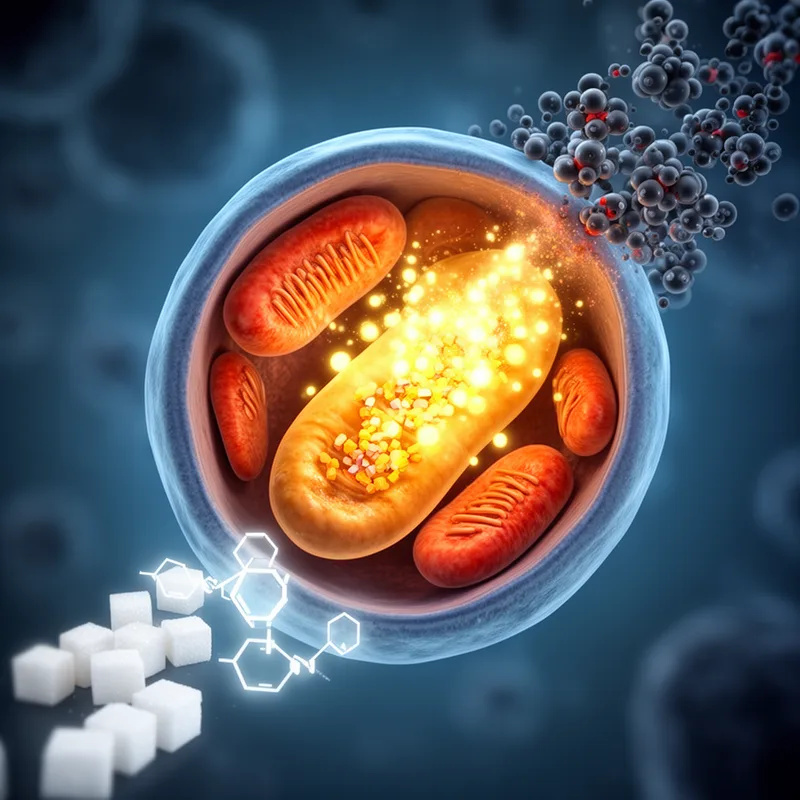
During cellular respiration, glucose is broken down to release energy that cells use for various functions.
-
Cellular respiration converts food into energy in the form of ATP, which is utilized by the body for metabolic processes.
Synonyms

 3
4.0
3
4.0

Cells change food into energy and make carbon dioxide
Surface Forms
Morphology
The meaning is directly compositional: 'cellular' means 'relating to cells' and 'respiration' denotes the metabolic process of producing energy, so together they indicate the energy-producing metabolic processes that occur in cells. A B1 learner who knows both constituents should be able to infer this sense (the phrase mainly disambiguates 'respiration' as cellular rather than pulmonary), and this compositional pattern is cross-linguistically common.
Etymology
The term cellular respiration comes from the simple image of cellular units called cells doing respiration, where respiration meant 'breathing'. So today it means the process cells use to 'get energy' from food and to release carbon dioxide.