

ceiba tree
- noun
- /ˈseɪbə trē/
- US
- The ancient ceiba tree stood tall, its ridged bark telling stories of the many seasons it had witnessed.
Examples
-
After passing the coral bed, the ceiba tree, and the topiary, he reached the edge of the orange grove.
Fiction book (1999) -
The majestic ceiba tree shades the front of the house and menaces the roof with its branches.
Academic text (2017) -
A solitary ceiba tree, with its lime green bark and shark teeth thorns, connected the land to the sky: its deep roots plunged to the core of Earth; its long branches stretched to the firmament.
Fiction book (1999) -
The enormous ceiba tree in the park is known for its thick trunk and beautiful silky fibers in its seed pods.
-
Children often play around the magnificent ceiba tree, enjoying the shade it provides on sunny days.
Synonyms



 1
9.9
1
9.9
A large tropical tree that makes seed pods with silky fibers used for stuffing

A large tropical tree that makes pods with seeds covered in soft floss used to stuff pillows
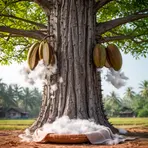
A very large tropical tree whose trunk has deep grooves and seed pods of soft, fluffy material used for stuffing

A very large tropical tree with a rough trunk and pods of soft fibers around seeds used for stuffing

A large tropical tree with a thick bumpy trunk that gives silky kapok fiber

A tall tropical tree with large bell-shaped flowers and seed pods full of silky fibers
How Big

Surface Forms
Morphology
The phrase denotes a tree of the Ceiba genus, so a learner who knows 'Ceiba' (a genus of tropical kapok trees) and 'tree' can infer it is a specific type of tree. This taxonomic noun+noun composition is straightforward and cross-linguistically common, making the meaning directly derivable from its parts.
Etymology
Ceiba tree is the name of a very large tropical tree with a thick trunk and seed pods full of soft, silky 'kapok' fibers. People used those fibers to fill pillows and mattresses, and the tree's wide branches gave shade for gatherings, so the Ceiba tree came to be seen as a useful and often sacred tree.