
caspase
 2
8.2

- noun
- /ˈkæspeɪs/
- Specialized
- Additionally, it has been reported that Beclin 1 contains caspase-cleavage sites 28, 29 and can be cleaved by caspases in vitro 30, 31.
- activating caspases
- caspase 8
- activation of caspase
Examples
-
In the context of neurodegeneration, the C-terminal fragment can potentiate the effect of caspase activation and exacerbate apoptosis and neuronal cell death.
Academic text (2018) -
Together, the BH3 domain and caspase-cleavage sites provide a direct mechanistic link to apoptosis and cell death.
Academic text (2018) -
Similarly, sham and control groups showed fewer active caspase-3-positive cells in the testis.
Blog text (23) -
The expression of activated caspase-3 was upregulated in septic rats.
Academic text (2018) -
A hallmark of apoptosis is the activation of caspases, including the executioner/effector caspase 3.
Academic text (2018) -
Overall, these effects led to cell cycle arrest in the G2/M phase, induction of caspase-dependent apoptosis, and growth suppression in multiple myeloma cells.
Academic text (2017) -
Caspases can cleave a wide range of substrates during apoptosis that eventually lead to cell death 53-57.
Academic text (2018) -
Studies in various cell lines in vitro have established a link between strong caspase-activating stimuli and Beclin 1 cleavage 28, 29, 32.
Academic text (2018) -
Furthermore, caspase inhibitors and neural overexpression of a caspase-cleavage resistant form of Beclin 1 confer neuroprotection in vivo.
Academic text (2018) -
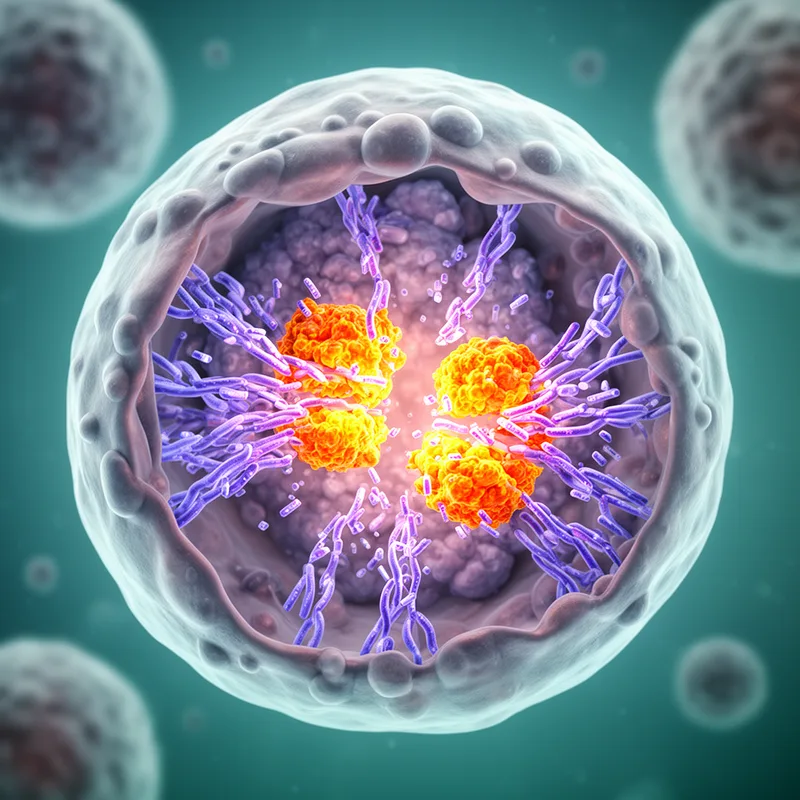
When a cell undergoes apoptosis, it typically activates enzymes called caspases that rip apart the cell's DNA and other molecules.
Compounds

- Specialized

 1
9.1
A planned way cells destroy themselves using caspase enzymes to remove damaged or dangerous cells
Surface Forms
Morphology
caspase = casp + ase
Although '-ase' is a productive enzyme-forming suffix, the root 'casp' is a technical combining form (not a standalone English word) so the composition is not transparent to an average B1 learner.
Etymology
Caspase was formed from the parts cysteine and aspartic plus the enzyme ending -ase. A helpful way to remember this is that -ase means 'enzyme' (as in lipase or protease), so a caspase is an enzyme that uses cysteine to cut proteins at aspartic acid, which is why caspases cause the controlled death of cells.