
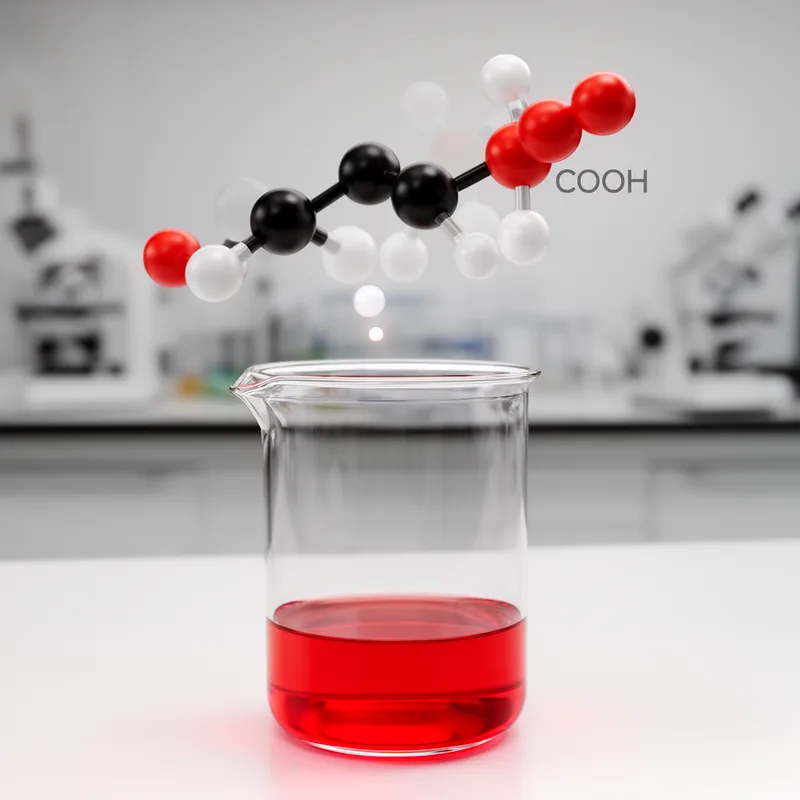
carboxylic acid


 1
6.1
1
6.1
- noun
- /kɑrˈbɑksɪlɪk ˈæsɪd/
- Specialized
- A carboxylic acid is an organic compound that contains a carboxyl group which gives it acidic properties.
- incorporation of carboxylic acid
Loading YouTube…
Watch on YouTubeSo we talked before about about converting the CN to carboxylic acid, OK?
- So we talked before about about converting the CN to carboxylic acid, OK?
Examples
-
Common examples of carboxylic acids include acetic acid, which is found in vinegar, and citric acid, which is present in citrus fruits.
-
So this here would be a carboxylic acid group drawn like this or like that.
-
Now you can also make carboxylic acids by reduction.
-
So we talked before about about converting the CN to carboxylic acid, OK?
-
Thus, the base-soluble functionality is primarily carboxylic acid in the 193-nm resist polymer.
Academic text (2001) -
Different DMAs and different carboxylic acids exhibit different effects on the dissolution/swelling behavior of cycloolefin polymers.
Academic text (2001) -
In contact with an aqueous alkaline developer, the carboxylic acid groups formed during deprotection will ionize, rendering the polymer soluble in the aqueous solution.
Academic text (2001) -
In organic chemistry, a carboxylic acid is identified by its functional group consisting of a carbon atom double-bonded to an oxygen atom and also bonded to a hydroxyl group.
Surface Forms
Morphology
This is a straightforward adjective + noun compound: 'carboxylic' (having carboxyl/–COOH groups) modifies 'acid', so the meaning is simply an acid that contains carboxyl groups. The composition follows regular scientific naming patterns (e.g. Spanish 'ácido carboxílico'), so a learner who knows both constituents can derive the overall meaning.
Etymology
Carboxylic acid comes from joining carboxyl and acid, which makes a clear picture. Carboxyl is the small part COOH that gives a molecule its 'sour' quality, so the name simply says the molecule has a carboxyl part and acts as an 'acid'.