
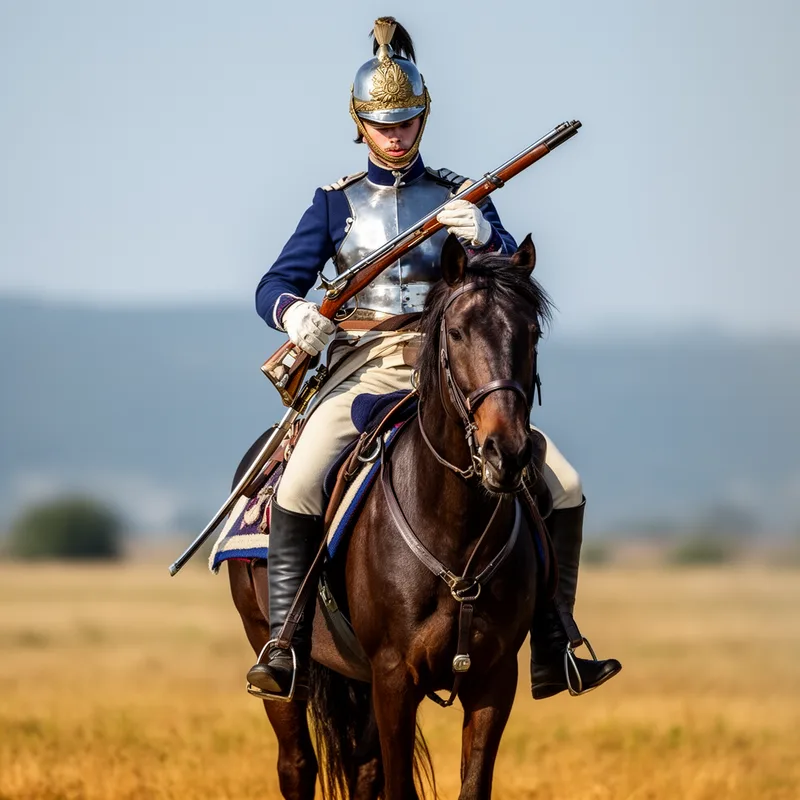
carabinier
- noun
- /ˌkærəˈbɪnɪr/
- Archaic
- A regiment of carabiniers charged across the battlefield on horseback.
Examples
-
The museum displayed the uniform of a carabinier from the Napoleonic Wars.
-
In the novel, the protagonist befriends a young carabinier stationed at the frontier.
-
The carabinier patrolled the streets with great vigilance.
-
Many carabiniers served bravely during the war.
-
A regiment of carabiniers charged across the battlefield on horseback.
-
The museum displayed the uniform of a carabinier from the Napoleonic Wars.
-
In the novel, the protagonist befriends a young carabinier stationed at the frontier.
Synonyms


 1
9.9
1
9.9
A soldier who fights on horseback and uses a short rifle

A soldier on horseback who carries a short rifle
Surface Forms
Morphology
carabinier = carbine (semi-transparent) = carabin + ier
The notion 'soldier armed with a carbine' is identifiable from 'carbine', but the form is a direct borrowing with the non-productive suffix '-ier', so the derivation is not fully transparent to an average learner.
Etymology
Carabinier comes from the French and Italian words for the short gun, carbine and carabina. So a carabinier was originally 'a soldier with a carbine', often on horseback, which is why the word means a soldier armed with a 'short gun'.