
capsomer


 1
9.9
- noun
- /ˈkæpsoʊmɚ/
- Specialized
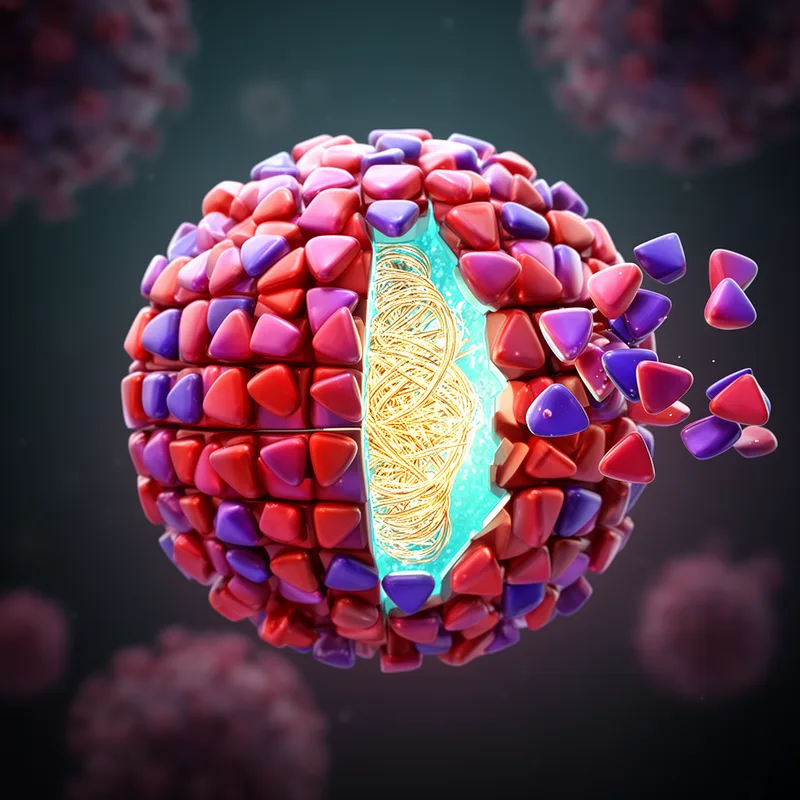
- Each capsomer is a crucial protein subunit that helps create the virus's capsid structure.
- capsomers and hexameric
- capsomer binding energy
- capsomer proteins
Examples
-
Turnip yellow mosaic virus, as shown on the left, has a roughly spherical capsid comprising 12 pentameric capsomers and 20 hexameric capsomers.
Academic text (2004) -
An antiviral agent would work at the molecular level, a scale below the disk-shaped capsomers of the UCLA model.
Academic text (2004) -
To see why, consider a capsid that has just one more capsomer than the number M at a minimum.
Academic text (2004) -
In each run of the model, a fixed number N of capsomers slid about on a sphere.
Academic text (2004) -
Although the same protein makes up both types of capsomer, it adopts three different shapes to form pentamers and hexamers, as shown on the right.
Academic text (2004) -
Figure 2 shows how the energy per capsomer varies with N for two cases: E = 0 (black curve) and E = kT (blue curve).
Academic text (2004) -
Their building bricks are capsomers: regular polygonal groupings of capsid proteins.
Academic text (2004) -
The ability of capsomer proteins to form pentamers and hexamers with equal ease spreads out the free-energy minima, making them easier for evolution to find.
Academic text (2004) -
The outer shell of the virus is composed of numerous capsomers that organize to form a protective layer.
-
During viral assembly, individual capsomers come together to form the complete capsid around the viral genome.
Surface Forms
Morphology
capsomer = capsid (semi-transparent) = capso + omer
Formed from the technical base 'capsid' + the combining element '-omer' meaning 'part', but both elements are specialized and likely unfamiliar to an average B1 learner.
Etymology
Capsomer comes from parts that mean 'box' and 'part': the capso- piece (seen in capsule) means 'box' or protective cover, and the ending -mer (seen in polymer) means 'part'. So a capsomer is a 'part' of the virus's outer 'cap' or shell, which is why it names the protein unit that helps make the virus's protective coat.