
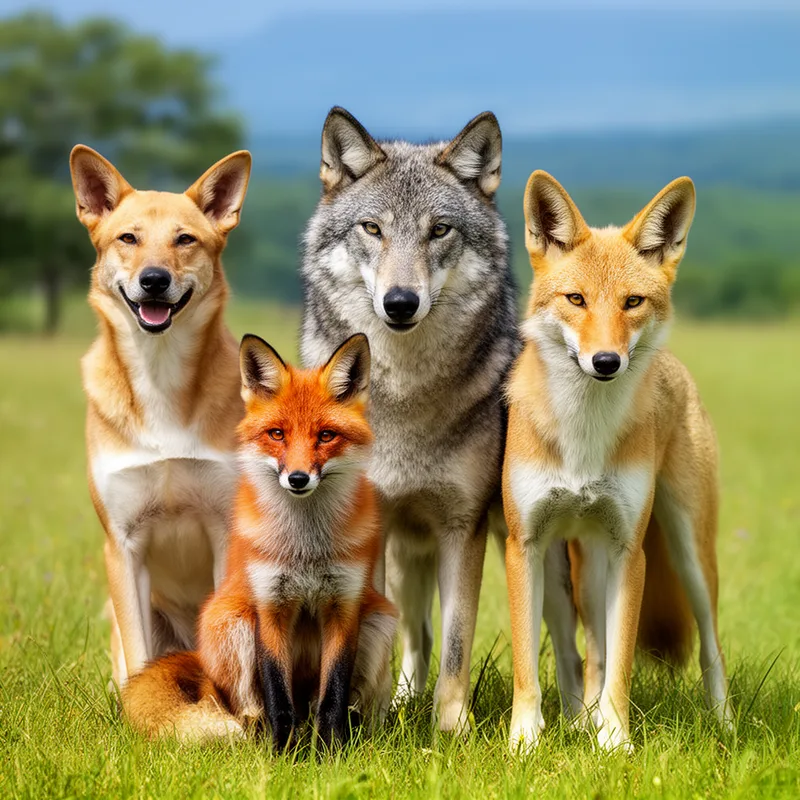
canid
 1
8.8
1
8.8

- noun
- /ˈkeɪnɪd/
- Specialized
- The thirty-eight species of wild canids inhabit diverse ecosystems, from deserts to arctic tundra.
- canid subfamily
- canid species
- large canids
Examples
-
Altogether, by about 30 million to 28 million years ago, twenty-five species of canids roamed western North America, a peak of diversity within a continent unequaled before or since by any single family of carnivoran.
Academic text (2008) -
Indeed, with eleven species, South America is home to almost one-third of the entire canid diversity on the planet.
Academic text (2008) -
It's far closer to the canids than to the felids.
-
Sometimes the canid was seen streaking through the cornfields.
-
Throughout history we find many legends and lore pertaining to canid creatures.
-
Coyotes, which evolved in North America, are small, versatile canids able to survive in diverse landscapes.
Blog text (28) -
But the gray wolf, Canis lupus, is one of the few exceptions and remains one of the most successful large canids in the world.
Academic text (2008) -
North American herbivores, the potential prey for canids, steadily diversified during the first half of the following epoch, the Miocene, which lasted from 23 million to 5 million years ago.
Academic text (2008) -
Coyotes, which evolved in North America, are small, versatile canids that can adapt to various environments.
-
African wild dogs, rare members of the canid family, have been sighted in regions where they were previously extinct.
Synonyms
 43
3.7
43
3.7
A mammal like a dog or fox that belongs to the dog family
Surface Forms
Morphology
canid = canine + Canidae (semi-transparent) = can + id
The stem 'can-' is identifiable as dog-related if learners know 'canine', but the scientific suffix '-id' is specialised, so precise taxonomic meaning may not be fully predictable.
Etymology
Canid comes from the Latin canis, meaning 'dog', and the same root appears in the word canine, so a canid is any animal of the 'dog' family, such as wolves, foxes, jackals, and domestic dogs.