
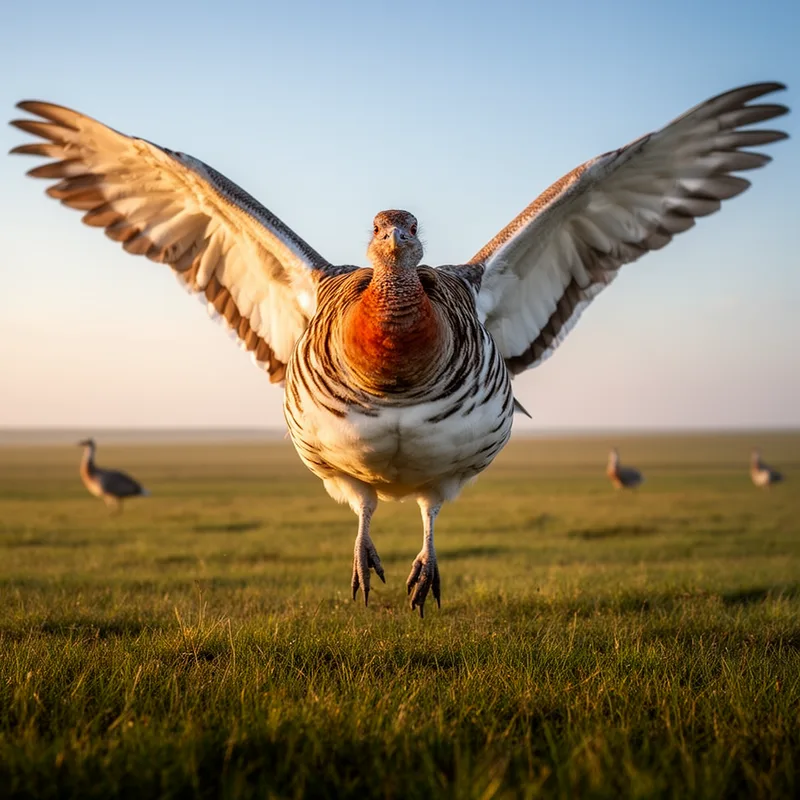
bustard
 1
9.6
1
9.6

- noun
- /ˈbʌstərd/
- Unhitching her mare, Aganippe went out with the dog pack, running down several hares and a big ground-dwelling bustard.
- kori bustard
- houbara bustard
- great bustard
Examples
-
Very large birds, such as the flamingo, secretary bird, bustard, crane, pelican, or the stork, and very small birds, such as the bee-eater, sunbird, and swallow, tend not to be killed as a practical matter.
Academic text (1998) -
Another conservation concern is a decline in the houbara bustard, Chlamydotis undulata, the ultimate quarry for many Arab falconers.
Academic text (2009) -
Back by the fire, Hercules had finished the bustard and was hard at work on the rabbits.
Fiction book (1996) -
A flock of bustards.
Blog text (7) -
And the varied displays of Yellow-necked Spurfowl, White-bellied, Black-backed, and Buff-crowned Bustards can be observed.
Academic text (2009) -
The latter bustard has the most amazing display: it has a neck-stretching call followed by an imitation of a short-range sky rocket; the bird fires itself into the air to a height of around 100 feet, tumbles over, and then falls toward Earth as if it has been shot, and only at the last moment does it flare its wings and land with some dignity.
Academic text (2009) -
Birds were crows, very much like, if not quite the same as, our English ones; parrots and paraquets most beautiful; white and black cockatoos; pigeons; beautiful doves; bustards; and many others which did not at all resemble those of Europe.
Blog text (30) -
The kori bustard is known for its impressive wingspan, allowing it to soar high above the plains.
-
While observing the vast savannah, we spotted a bustard gracefully strutting through the tall grass.
-
In the nature reserve, a rare bustard was seen taking flight in search of food.
Synonyms
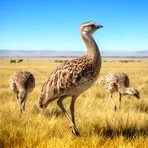
Large ground birds like bustards that live in open grasslands in Africa and Eurasia
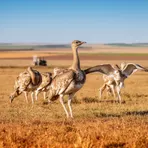
Large ground birds called bustards that live in Africa, Europe, Asia, and Australia
Compounds
- Specialized
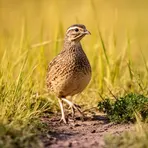
A small ground bird like a quail in Eurasia and Africa that has no hind toe and lives in grass

A very large bird from Europe and Asia that is the heaviest flying bird in Europe
Surface Forms
Etymology
The word bustard comes from old Latin avis 'bird' and tardus 'slow', so it once meant 'slow bird' and shares the tard- root with English tardy. That's why a bustard is a large, heavy bird that often walks slowly across open plains even though it can fly strongly.