
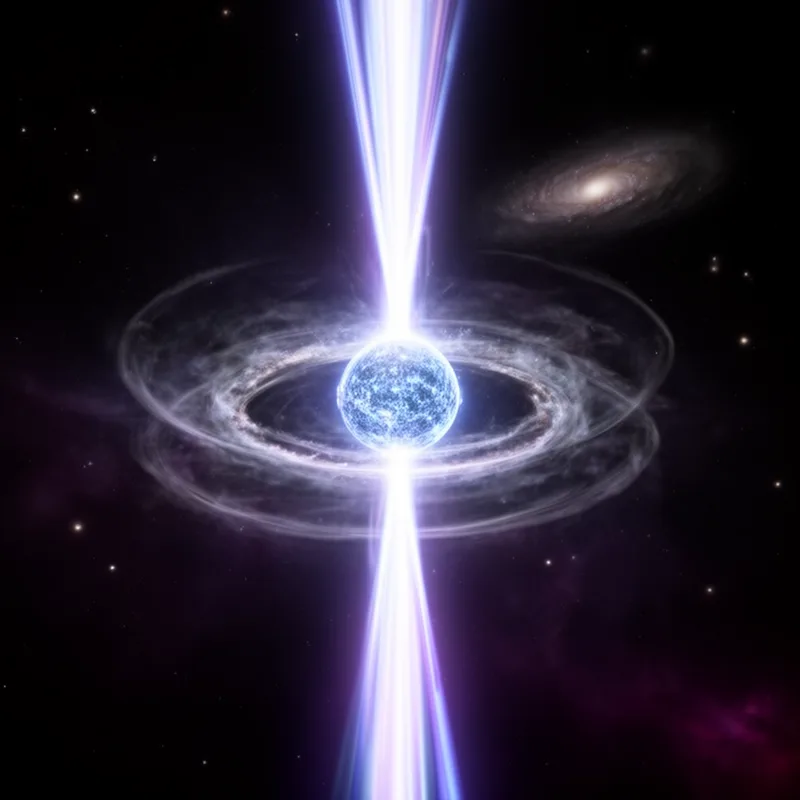
burster
- noun
- /ˈbɜrstər/
- Specialized
 :
emisor de rayos gamma
:
emisor de rayos gamma
- Slow transfer onto a neutron star leads to X-ray binaries with accretion disks and gamma-ray bursters that explosively burn helium on their surfaces.
- gamma-ray bursters
Examples
-
If gamma-ray bursters do come from these extreme distances, they must be extraordinarily powerful to appear as bright as they do to detectors aboard GRO.
Academic text (1994) -
By the time the universe was 1 billion years old, it contained small galaxies, gamma-ray bursters, and even bright quasars likely powered by supermassive black holes as heavy as a billion suns.
Academic text (2011) -
This indicates either that the bursters do not go on forever or that they are located in the farthest reaches of space.
Academic text (1996) -
During their short lifetimes, bursters outshine all other gamma-ray sources combined.
Academic text (1990) -
However, astronomers Jean Quashnock and Don Lamb of the University of Chicago may have found evidence that many bursters do, in fact, repeat their outbursts.
Academic text (1994) -
The question of whether gamma-ray bursters repeat or not may never be resolved until we have several satellites in different parts of the solar system capable of detecting bursts.
Academic text (1994) -
Localized sources of gamma rays include supernovae, quasars, the centers of active galaxies, pulsars, neutron stars, gamma-ray bursters, and black holes.
Academic text (1990) -
Astronomers have detected a new burster releasing intense gamma rays from deep space.
-
The star known as the 'Rapid Burster' is notable for its frequent bursts of X-ray radiation.
-
Researchers believe that every burster has the potential to significantly outshine other cosmic objects during its explosive episodes.
Synonyms
A very large star that falls in on itself and becomes a black hole, making very strong bursts of energy

A small red star that suddenly becomes much brighter for a few minutes because of explosions on its surface
Antonyms
Surface Forms
Morphology
Etymology
Burster comes from burst ('a sudden release') plus -er ('that which'), and the name fits the sky as well as machines. In astronomy a burster is an object that sends out sudden, intense flashes of X-rays or gamma rays, so the word describes its quick, powerful bursts of radiation.

