
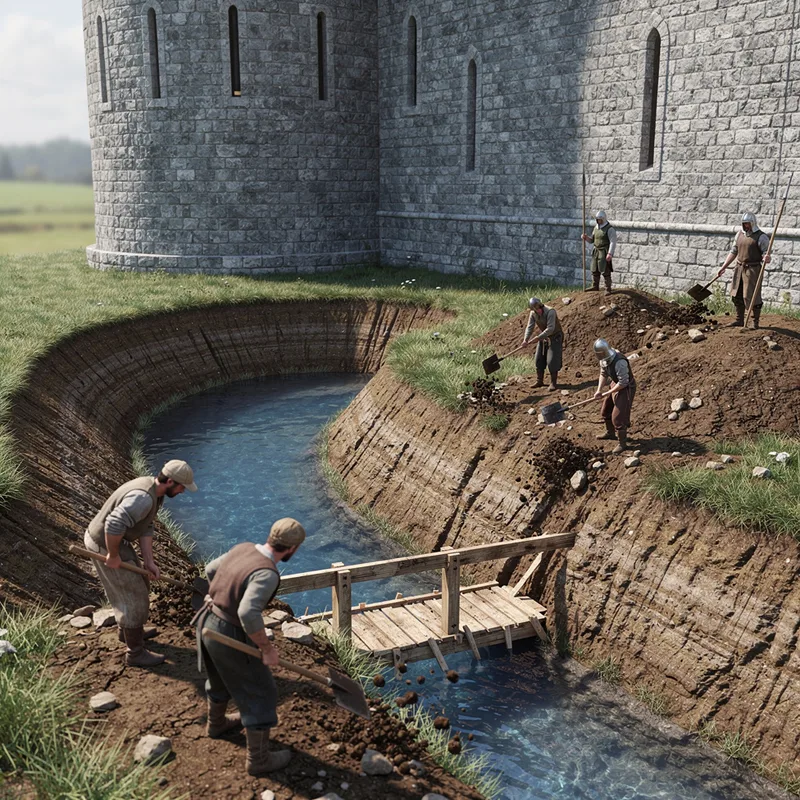
to build a moat
 2
7.4
2
7.4

- idiom
- /bɪld ə moʊt/
- In the story, the villagers worked together to build a moat to defend against their enemies.
Examples
-
Otherwise, why would zoos build moats around their monkey and ape compounds?
Academic text (1995) -
As evidence, he notes that the villagers built their defensive moat within inches of the ditches of the old enclosure.
Academic text (2006) -
On his second day, he's going to build a moat, and since he's truly fond of becoming royalty, he will change the designation of the White House to Palace.
Blog text (21) -
Last summer, we decided to build a moat around the castle for added security.
-
The architects designed a plan to build a moat that would protect the estate from intruders.
Synonyms


Antonyms

How Defensive

Surface Forms
Morphology
The literal meanings of 'build' (create) and 'moat' (a defensive ditch) map clearly onto the idea of creating a protective barrier, so a B1 learner who knows the words can infer the general sense of making protections around something. However, the specific business nuances (patents, network effects, brand strength) are a metaphorical extension requiring domain awareness, so the expression is not fully compositional.
Etymology
Build a moat comes from old castles: people would build a deep, wide moat filled with water around a castle so enemies could not easily get in. That's why it means 'to protect a place from attack'.