

bugle call
 2
5.6
2
5.6

- noun
- /ˈbjuːɡl kɔːl/
- The music was heard and appreciated by other brigades, who asked for copies and adopted this bugle call.
- hear a bugle call
- sound a bugle call
Loading YouTube…
Watch on YouTubeYou'll hear a lot of horn calls, like bugle calls on the soundtrack at this point.
- You'll hear a lot of horn calls, like bugle calls on the soundtrack at this point.
Examples
-
Aficionados of Westerns should recognize the plaintive strains of Taps, the bugle call played at sunset on army posts, and at military funerals as well.
Fiction book (2002) -
It sounded like a bugle call at a military post in a movie.
Fiction book (1990) -
One thing about this brigade is we got our own special bugle call.
-
I could hear the distant drums and sounds of bugle calls
-
They can play a bugle call
-
Barnaby loved that bugle call!
Fiction book (1998) -
This music was made the official Army bugle call after the war, but it was not given the name "taps" until 1874.
Blog text (27) -
The 24-note melancholy bugle call known as "taps" is thought to be a revision of a French bugle signal called "tattoo" that notified soldiers to cease an evening's drinking and return to their garrisons.
Blog text (27) -
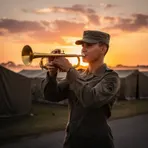
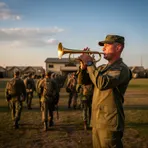
The soldiers stood in formation as the bugle call signaled the start of the ceremony.
-
At dawn, they would wake up to the familiar sound of a bugle call echoing across the camp.
Synonyms
 7
9.8
7
9.8
A signal played on a bugle to wake soldiers at sunrise
 6
8.7
6
8.7
A drum or bugle call that tells soldiers to return to their sleeping place
 2
8.5
2
8.5
A bugle call that tells soldiers to return to camp
 2
8.5
2
8.5
A short bugle tune played at night to signal lights out or show respect at military funerals
Surface Forms
Morphology
The meaning ('a signal or tune played on a bugle') is directly derivable from combining 'bugle' (a brass instrument used for signals) with 'call' (a sound or signal). This straightforward instrument+sound composition is common and follows transparent English compounding patterns, so a B1 learner who knows both words would readily understand the MWE.
Etymology
The phrase bugle call comes from army life: a bugle is a small brass horn that soldiers used to play short tunes, and a call was the sound that told people what to do, like wake up or gather. That's why a bugle call means 'a signal or tune used to mark a time or event'.