

brand-name drug
 3
4.2
3
4.2

- noun
- /brænd neɪm drʌg/
- Specialized
- The doctor prescribed a brand-name drug that is known for its effectiveness in treating allergies.
- generic versus brand-name drugs
- brand-name drug makers
- brand-name drug prices
Examples
-
Many patients prefer brand-name drugs because they trust the quality associated with recognizable labels.
-
The manufacturers of generic drugs are held to the same FDA standards as the makers of brand-name drugs.
Blog text (18) -
This is done by requiring prior authorization for the use of the brand-name drug by the consumer.
Blog text (1) -
The profits are to be found in ordering expensive tests and prescribing brand-name drugs.
Blog text (10) -
It is exactly the same as the brand-name drug; it just doesn't carry that brand name.
Blog text (23) -
As a result, one health plan strategy relies on requiring the use of low-cost medication before one buys the brand-name drugs.
Blog text (1) -
Insurers set high co-pays for brand-name drugs to steer their members to less-expensive generics.
Blog text (34) -
In a pay-for-delay settlement, a brand-name drug company pays a generic company that has challenged the brand-name company's patent to stay out of the market.
Blog text (6) -
In 2013, Medicare Part D's coverage of brand-name drugs will begin to increase, so people with Medicare will receive approximately 53 percent off the cost of brand-name drugs, and coverage for 21 percent of the cost of generic drugs in the donut hole.
Blog text (13) -
Insurance plans often require higher co-pays for brand-name drugs compared to their generic counterparts.
Synonyms

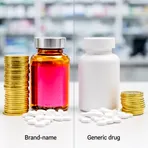
A medicine sold under a brand name that only one company can make
Antonyms
- Specialized
9
3.7
A medicine that has the same dose and effect as a brand-name medicine but costs less
How Branded

Surface Forms
Morphology
brand-name + drug
The phrase is compositionally built: 'brand-name' signals a product sold under a manufacturer's brand or trademark and 'drug' means a medicine, so a learner who knows both parts can infer this refers to the commercially branded (as opposed to generic) version of a medicine. This meaning is a straightforward combining of constituent senses and is cross-linguistically common, so it should be accessible to a B1 learner.
Etymology
Brand-name drug comes from the idea of a medicine a company sells under its own brand and name, like a well-known product with a logo. Because the company has a 'patent' or 'legal right' to sell it alone for some time, the phrase means a medicine sold under that company's name and often more expensive than a generic.