
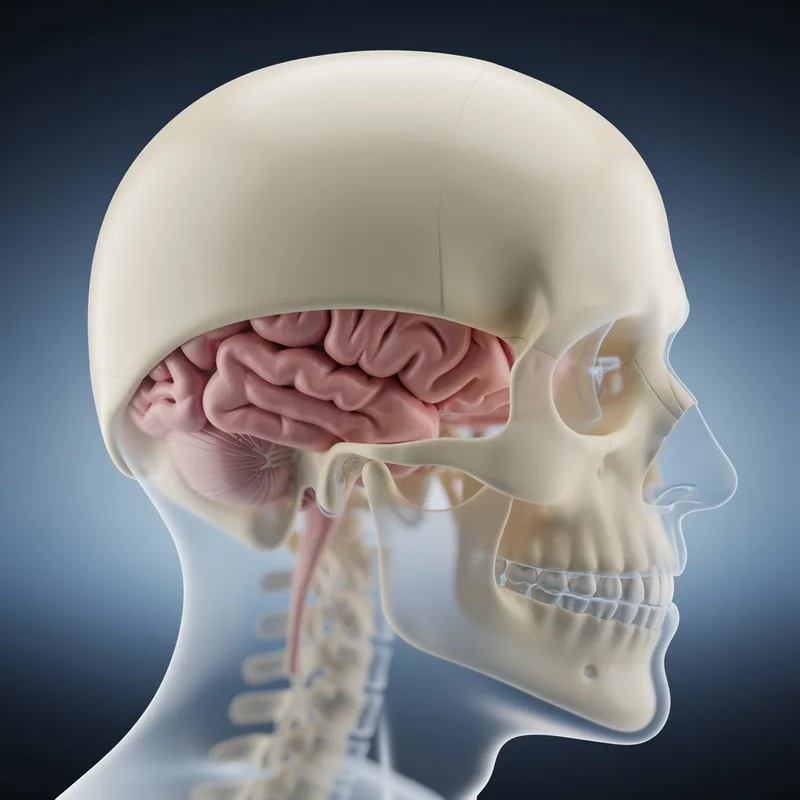
braincase
 1
7.0
1
7.0

- noun
- /ˈbreɪnˌkeɪs/
- Specialized
- Scientists examined the braincase to better understand the evolutionary changes in early humans.
Examples
-
If he was a typical Neanderthal, his braincase probably was larger than a normal man's.
Fiction book (2002) -
The points at which the jaws attach to the braincase define the type of jaw suspension.
Academic text (2003) -
There are three basic ways in which the jaw is suspended from the braincase.
Academic text (2003) -
The zygomatic and braincase breadths were 19.78 mm and 15.44 mm, respectively.
Academic text (2014) -
I remember reading somewhere that the average Cro-Magnon skull (of which there are admittedly very few) had a 10% bigger braincase capacity than the average modern human skull of today.
Blog text (22) -
Working with Hans Larsson, a graduate student in paleontology at the university, Andersen had taken CAT scans of dinosaur braincases.
Academic text (2000) -
Steele and Powell (1992, 1993, 1994) have provided information that early North American populations differed in appearance from living Native Americans and northern Asians by having a relatively longer and narrower braincase and a narrower face.
Academic text (1996) -
The ancient skull revealed a large braincase that provided insight into the species' intelligence.
-
The braincase of the prehistoric creature was remarkably intact, making it a significant find for researchers.
Synonyms
 415
1.3
415
1.3
A bony structure of the head that protects the brain
 20
5.7
20
5.7
The part of the skull that covers and protects the brain
 2
9.6
2
9.6
The hard part of the skull that covers and protects the brain inside the head
 1
5.3
1
5.3
Space inside the skull that holds the brain
Surface Forms
Morphology
Etymology
Braincase comes from the two simple words brain and case, where case means 'container' or 'box', like a briefcase. So a braincase is the 'container' that holds and protects the brain, which is why it names the part of the skull that keeps the brain safe.