

bottlenose whale


 1
7.2
1
7.2
- noun
- /ˈbɑtəlˌnoʊz weɪl/
- UK
- As the years went by, a handful of other sightings of bottlenose whales in the Tropics came trickling in, and scientists gradually accepted that they were probably southern bottlenose whales, a fairly common species but one normally found only in Antarctic waters.
- southern bottlenose whale
Examples
-
I myself had seen bottlenose whales in the tropics at least ten times, and southern bottlenose whales in Antarctica dozens of times, and the two groups looked very similar to me.
Academic text (2002) -
The link was forged—our tropical bottlenose whale was indeed Longman's long-lost whale!
Academic text (2002) -
Tropical bottlenose whales, seen alive in the Pacific rather than on a museum shelf.
Academic text (2002) -
I realized that the bottlenose whale in the tropics was not the southern bottlenose whale.
Academic text (2002) -
I myself had seen bottlenose whales in the tropics at least ten times, and southern bottlenose whales in Antarctica dozens of times, and the two groups looked very similar to me.
Academic text (2002) -
As the years went by, a handful of other sightings of bottlenose whales in the Tropics came trickling in, and scientists gradually accepted that they were probably southern bottlenose whales, a fairly common species but one normally found only in Antarctic waters.
Academic text (2002) -
The bottlenose whale swam gracefully near the boat, showcasing its bulbous forehead and distinct beak.
-
During a whale-watching tour, we spotted a bottlenose whale breaching the surface of the water.
-
In the documentary, the bottlenose whale was shown diving deep in search of squid, highlighting its remarkable hunting skills.
Synonyms
 1
8.8
1
8.8
A whale with a long beak and rounded forehead that lives in the northern Atlantic

A large whale with a long pointed nose and round forehead that lives in the North Atlantic
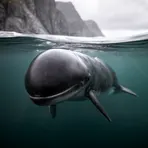
A whale with a rounded forehead that lives in the North Atlantic
Surface Forms
Morphology
The phrase is a straightforward noun-noun compound: 'bottlenose' specifies the type of nose/forehead and 'whale' names the animal, so the meaning (a whale with a bulbous forehead/beak) is directly derivable from the parts. This kind of descriptive compounding follows common English and cross-linguistic patterns, so a learner who knows both constituents will readily understand it.
Etymology
Bottlenose whale gets its name from the animal's head: its round, sticking-out nose looks a little like the top of a bottle. So the name simply describes this large whale with a round forehead and a long beak, helping people recognise it.