
bosonic string theory
- noun
- /bəˈzɒnɪk strɪŋ ˈθɪəri/
- Specialized
- Bosonic string theory predicts a 26-dimensional universe, which is not consistent with observed physical reality.
Examples
-
Researchers often study bosonic string theory as a simpler model before tackling more complex versions like superstring theory.
-
Although bosonic string theory is mathematically consistent, it fails to include fermions, which are essential particles in nature.
-
The foundation of bosonic string theory was laid in the late 1960s.
-
Many physicists study bosonic string theories to understand fundamental forces.
-
Bosonic string theory requires 26 dimensions to maintain its mathematical consistency.
-
In the late 1960s, researchers developed bosonic string theory to describe a universe made only of bosons.
-
Many theoretical physicists examine bosonic string theory as an initial approach to understanding the universe's fundamental aspects.
Surface Forms
Morphology
The phrase is compositionally built from its parts: 'bosonic' (pertaining to bosons) + 'string' + 'theory' yields a theory about bosonic strings, so a learner who knows the constituent meanings can infer the basic referent. Detailed technical implications (e.g. the historical origin or the 26-dimensional requirement) go beyond simple composition, but the core meaning is directly derivable from the words.
Etymology
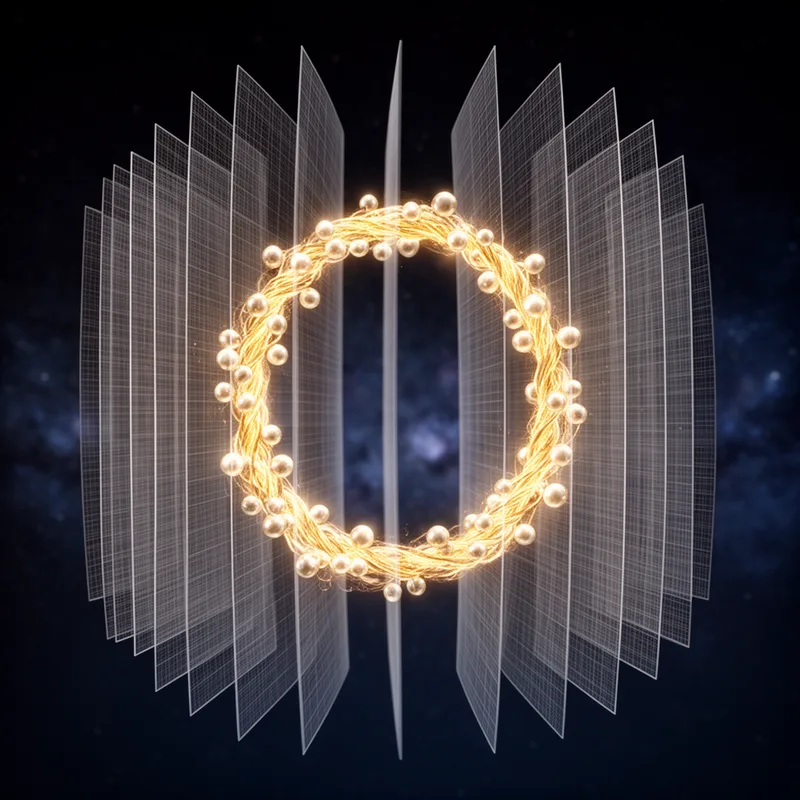
Bosonic string theory paints a simple picture: tiny, vibrating strings that make only one kind of particle — the bosonic part means 'bosons'. Because the math for these strings only works in '26 dimensions', this original, simpler model describes only 'bosons' and is used as a starting point for more complete theories.

