
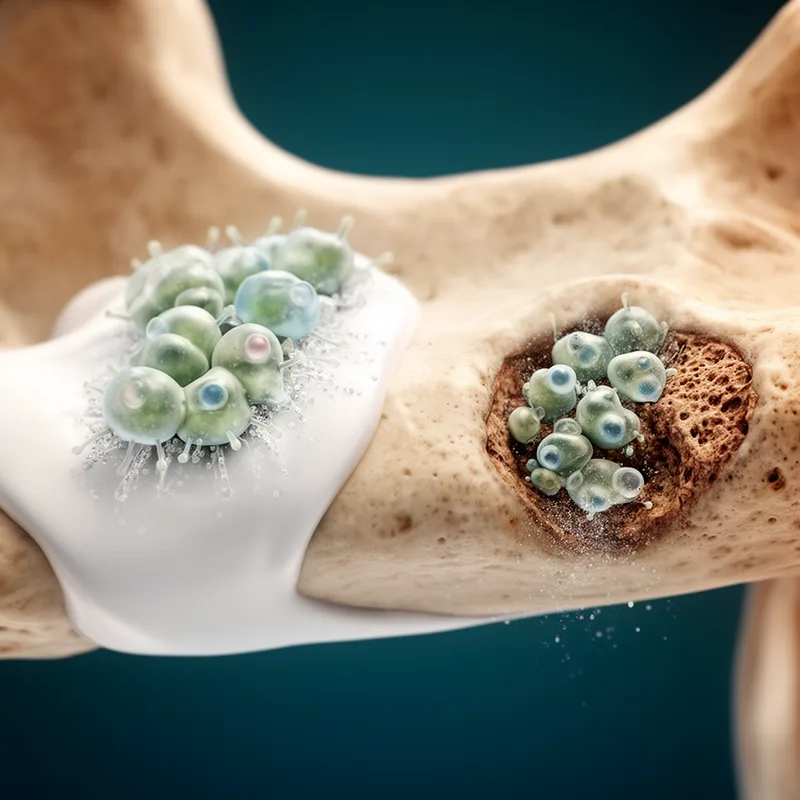
bone cell
 1
3.7
1
3.7

- noun
- /boʊn sɛl/
- Specialized
- The effects of exogenous glucocorticoids on bone and bone cells have been relatively well established (8, 9).
- bone cell regeneration
- stimulate bone cells
Loading YouTube…
Watch on YouTubeWe need eyeball cells and stomach cells and knee joint cells and foot cells and bone cells and brain cells.
- We need eyeball cells and stomach cells and knee joint cells and foot cells and bone cells and brain cells.
- In other words, a red cell becomes a bone cell and that is what heals the fracture and it completely regenerates it so that there's no scar.
- You need stronger bones that is transformed into a biochemical signal that makes your bones that your bone cells lay down new bone.
Examples
-
You need stronger bones that is transformed into a biochemical signal that makes your bones that your bone cells lay down new bone.
-
You don't become a bone cell or a blood cell, whereas this cell keeps that ability, which is a miraculous ability to become any cell.
-
We need eyeball cells and stomach cells and knee joint cells and foot cells and bone cells and brain cells.
-
But one of the things that they can't figure out, because if we put these bone cells in a Petri dish, they don't act the same way as they do in the body.
-
In other words, a red cell becomes a bone cell and that is what heals the fracture and it completely regenerates it so that there's no scar.
-
Bone cells, such as osteocytes, play a crucial role in maintaining the strength of your bones.
-
Researchers are investigating how different nutrients affect the health and function of bone cells in the body.
-
In aging populations, the activity of bone cells decreases, leading to an increased risk of fractures.
Surface Forms
Morphology
The meaning 'a cell that is part of bone tissue' is directly and transparently derived from combining 'bone' (the calcified tissue) with 'cell' (microscopic living unit); the compound simply names a cell located in or associated with bone. This noun–noun composition is common in English and other languages and follows predictable biomedical naming patterns, so a B1 learner who knows both constituents will readily infer the meaning.
Etymology
Bone cell names a tiny living part inside a bone: bone shows where it lives and cell shows it is a small living unit. These 'workers' make and repair bone, so the name now means a cell that builds or keeps bone tissue.