
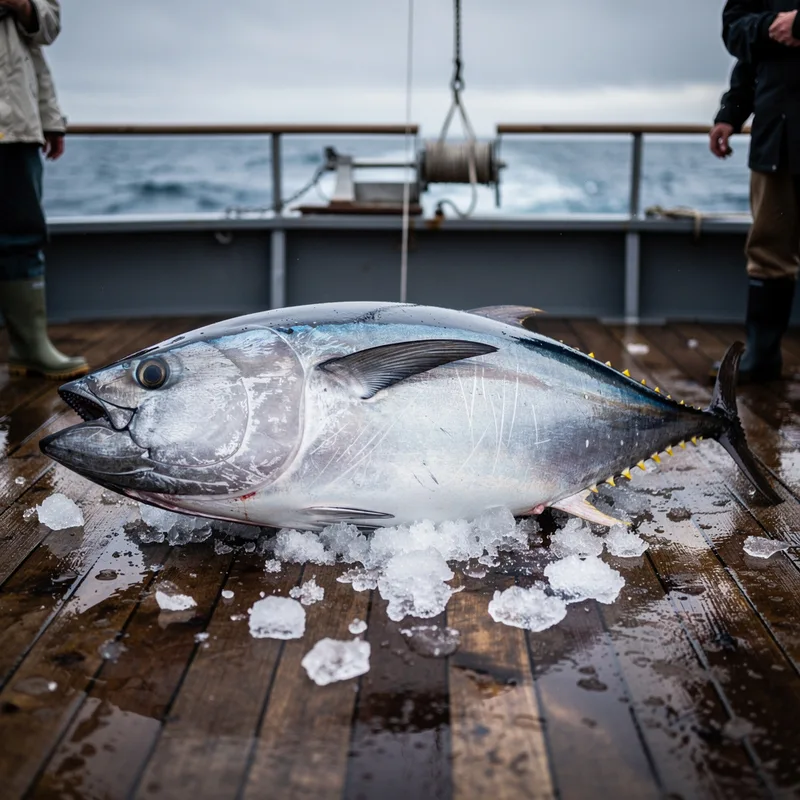
bluefin tuna
 1
3.2
1
3.2

- noun
- /ˈbluːfɪn ˈtuːnə/
- Australia's commercial exploitation of southern bluefin tuna started in 1949.
- southern bluefin tuna
Examples
-
During the summer months, restaurants often feature bluefin tuna in their sushi dishes, showcasing its rich flavor.
-
Incredibly, we're still killing bluefin tuna, truly endangered and much more valuable alive than dead.
-
Even aggressive efforts by the conservation community have been unable to prevent the continued destruction of bluefin tuna.
Academic text (1998) -
The southern bluefin tuna, like its Atlantic cousin, is valued for its raw cut flesh or sashimi.
Academic text (2002) -
The southern bluefin tuna feedlot industry grew rapidly to become South Australia's number-one export industry.
Academic text (2002) -
Although it is not yet on the same scale as salmon aquaculture, the farming of other carnivorous, highly valued species such as bluefin tuna, cod, and halibut is on the rise in different regions around the world (including, for some of these species, the Pacific Northwest).
Academic text (2003) -
The fishermen celebrated their catch of a massive bluefin tuna weighing over 600 pounds.
-
At the market, the price of a fresh bluefin tuna can exceed several thousand dollars.
Synonyms
 3
5.7
3
5.7
A very large tuna that lives in cool seas and is caught to sell
A very large tuna that lives in the Atlantic and is often eaten as sushi
Surface Forms
Morphology
The phrase names a species of tuna characterized by blue fins, so its meaning is directly compositional from the constituents ('bluefin' as a type/descriptor and 'tuna' as the fish). This descriptive, noun + noun naming pattern is common and predictable across languages, so a B1 learner who knows the parts would understand it.
Etymology
The noun bluefin tuna comes from the fish's dark blue back and fin, which made it easy for fishermen to spot at sea. So bluefin tuna now means the very large, valuable type of tuna people catch and eat.