

blue goose
- noun
- US
- The blue goose migrates annually between the Arctic and southern United States.
Examples
-
Unlike the white morph, the blue goose has distinctive slate-colored feathers.
-
Birdwatchers were excited to spot a rare blue goose among the flock.
-
Look at that blue goose!
-
I spotted a blue goose near the lake.
-
Birdwatchers were excited to spot a rare blue goose among the flock.
-
The blue goose migrates annually between the Arctic and southern United States.
-
Unlike the white morph, the blue goose has distinctive slate-colored feathers.
Synonyms

 34
1.0
34
1.0

A large water bird with webbed feet and a long neck that often flies south in groups in autumn
 1
2.8
1
2.8
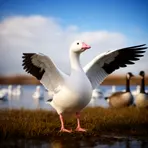
A white goose with black wing tips found in North America

A North American wild goose that is dark in summer and white in winter
Surface Forms
Morphology
The meaning is directly compositional: 'blue' describes the color and 'goose' names the bird, so a B1 learner who knows both words will understand it refers to a goose with blue-colored plumage. This color+animal construction is a common, cross-linguistic pattern and does not involve idiomatic or metaphorical shift.
Etymology
Blue goose comes from the bird's color: the parts blue and goose are literal—blue describes the dark gray feathers and goose is the bird, so people called that dark form the blue goose to tell it from the white ones. That's why blue goose today means a 'color variant' of the snow goose.