

blowing
 38
7.3
38
7.3

- noun
- /ˈbloʊɪŋ/
- Specialized
- The engineers tested the new machinery by measuring the speed of the blowing air flow during production.
- blowing air
- blowing apparatus
- blowing agent
Loading YouTube…
Watch on YouTubeTraditionally, cooling microchips works by blowing air over them.
- Traditionally, cooling microchips works by blowing air over them.
Examples
-
The tide was up, the wind blowing spindrift across the shaky pier.
Fiction book (1999) -
We're also at the tail end of the blowing season that began last November and ends in May.
Academic text (1994) -
But then I have that blowing on those plants to circulate the air.
-
Traditionally, cooling microchips works by blowing air over them.
-
Twenty feet further into the murkiness, he felt a breeze blowing and the beginnings of the current moving on his right.
Fiction book (2001) -
The hard, wind-driven pellets of sleet, mixed now with the blowing snow, stung his uncovered nose and lips.
Fiction book (2001) -
The blowing of gas through the pipeline was carefully monitored to ensure efficiency.
-
In the lab, the experiment required precise control over the blowing of nitrogen to achieve the desired results.
Synonyms
 13
3.5
13
3.5
The movement of air through or around things
 1
2.8
1
2.8
Movement of air through a space or system
 1
2.6
1
2.6
Air moving through a place or system


 1
3.5
1
3.5
A flow of air moving through a space, often as a breeze or strong gust
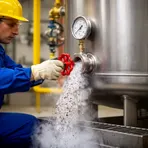
Controlled release of fluid from a boiler or pipe that lowers pressure and removes unwanted material

A stream of air that cleans a surface by blowing away dust

Blowing gas into something for a religious ceremony or medical use
Antonyms

Idioms

Compounds



- Specialized
Gas that comes out of a furnace when machines push air or steam through hot material
How Strong

Surface Forms
Morphology
Etymology
Blowing comes from an old English word blow, which meant 'to breathe' or 'push air', like when you blow out a candle. So in science and industry, blowing means sending air or gas with force, a controlled, strong 'breath' used to move, shape, or clean things.