
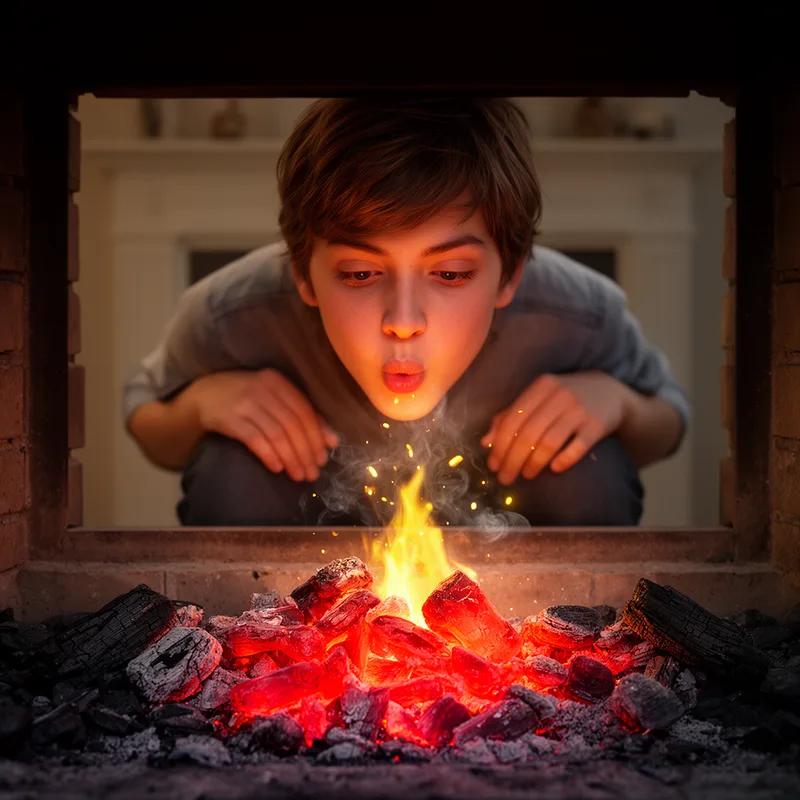
to blow the coals
- idiom
- He crouched by the hearth and began to blow the coals with careful breaths.
Examples
-
Old campfire manuals often instruct you to blow the coals gently to revive a dying flame.
-
Before adding more wood, remember to blow the coals so the fire stays hot.
-
He loves to blow the coals to keep the fire alive.
-
Can you blow the coals for me?
-
Before adding more wood, remember to blow the coals so the fire stays hot.
-
He crouched by the hearth and began to blow the coals with careful breaths.
-
Old campfire manuals often instruct you to blow the coals gently to revive a dying flame.
Synonyms
 7
5.6
7
5.6

To add fuel or stir a fire to make it burn hotter
Antonyms


How Hot
7
5.6

Surface Forms
Morphology
The meaning 'to make a fire burn hotter by blowing air on the coals' is directly and literally compositional from 'blow' (to force air out) + 'coal' (hot ember), with 'the' as a determiner. This is a concrete, physical action with close cross-linguistic parallels (e.g. Spanish 'soplar las brasas'), so a B1 learner who knows the constituent words would readily infer the meaning.
Etymology
The phrase blow the coals comes from a simple image: you blow on hot coals with your breath to make them glow and start a bigger flame. That's why it means 'to make a fire burn hotter or ignite'.