
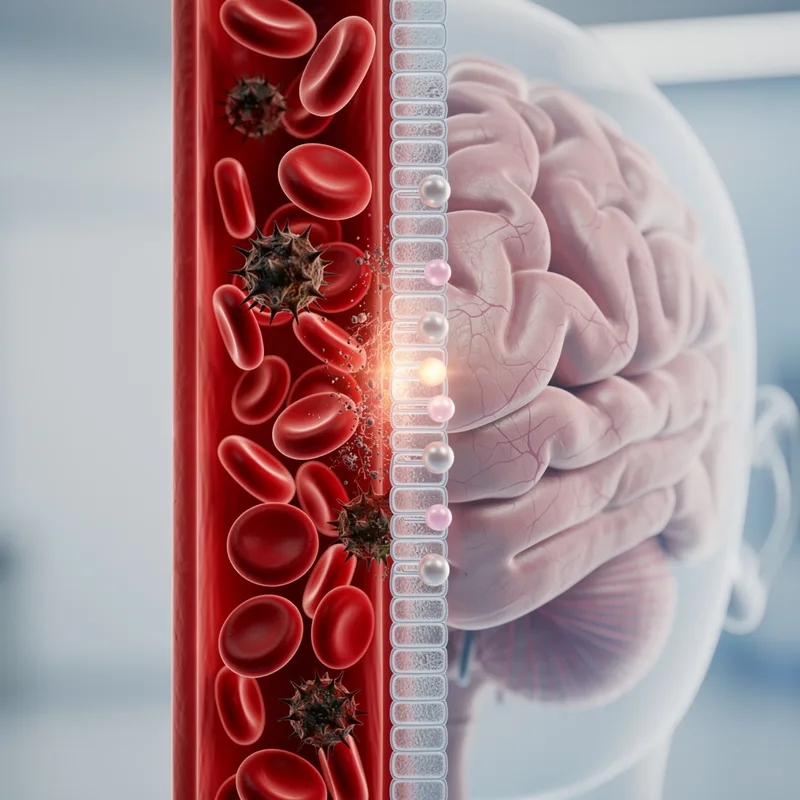
blood-brain barrier
 3
5.1
3
5.1

- noun
- /blʌd-breɪn ˈbɛriər/
- Specialized
- When studying brain health, scientists often examine how the blood-brain barrier regulates the entry of nutrients and toxins.
- cross the blood-brain barrier
Loading YouTube…
Watch on YouTubeAnd for children, their blood brain barrier isn't fully developed.
- And for children, their blood brain barrier isn't fully developed.
- That part of the brain does not have a blood brain barrier, so it's very vulnerable to toxins.
- So I think there could be indirect effects of forms of magnesium that do not cross the blood brain barrier.
- DHA and EPA, these Omega threes are two of the very few nutrients that can literally cross that blood brain barrier and feed your brain cells.
- And that's why you have a blood brain barrier or a BBB.
- It does cross the blood brain barrier and helps with neurotransmission and with your mood.
- So one thing is it opens up the blood brain barrier.
- So things that can heal your gut barrier can also heal your blood brain barrier.
- Of course it goes to the brain and it can get across this blood brain barrier and can help fuel the brain.
- And so it's one way for things to, let's say, not quite cross the blood brain barrier.
- First of all, it actually has to get through the blood brain barrier through an active transport, a lot of work.
- Gets across the blood brain barrier, Oxytocin goes up and levels of sociability do not increase.
- So so the goal is to to create endo bodies naturally that go in that that cross the blood brain barrier and engage the toxic forms of a beta plaque.
Examples
-
We know with fasting and the ketogenic diet that you can increase permeability to the blood brain barrier, things get through faster.
-
It crosses the blood-brain barrier and affects the central nervous system.
-
Of course it goes to the brain and it can get across this blood brain barrier and can help fuel the brain.
-
First of all, it actually has to get through the blood brain barrier through an active transport, a lot of work.
-
Normally we have a very tight blood brain barrier where very little can get across into our brain.
-
And for children, their blood brain barrier isn't fully developed.
-
That part of the brain does not have a blood brain barrier, so it's very vulnerable to toxins.
-
It does cross the blood brain barrier and helps with neurotransmission and with your mood.
-
Another property of this incredible antioxidant is that it passes through the blood-brain barrier.
Blog text (6) -
So we know that hormones like testosterone and cortisol cross the blood brain barrier and binds receptors and influence activity in the brain.
Surface Forms
Morphology
blood-brain + barrier
The phrase transparently combines the known nouns 'blood' and 'brain' with 'barrier', so a learner who knows those words can infer it denotes a barrier between the blood and the brain that protects access. This is a compositional, descriptive medical term with equivalents in many languages, making the meaning directly derivable for B1 learners.
Etymology
Blood-brain barrier paints a clear picture: a protective wall between the blood and the brain that keeps harmful things out. So it means the body's natural barrier that separates blood from the brain and 'protects' it.