
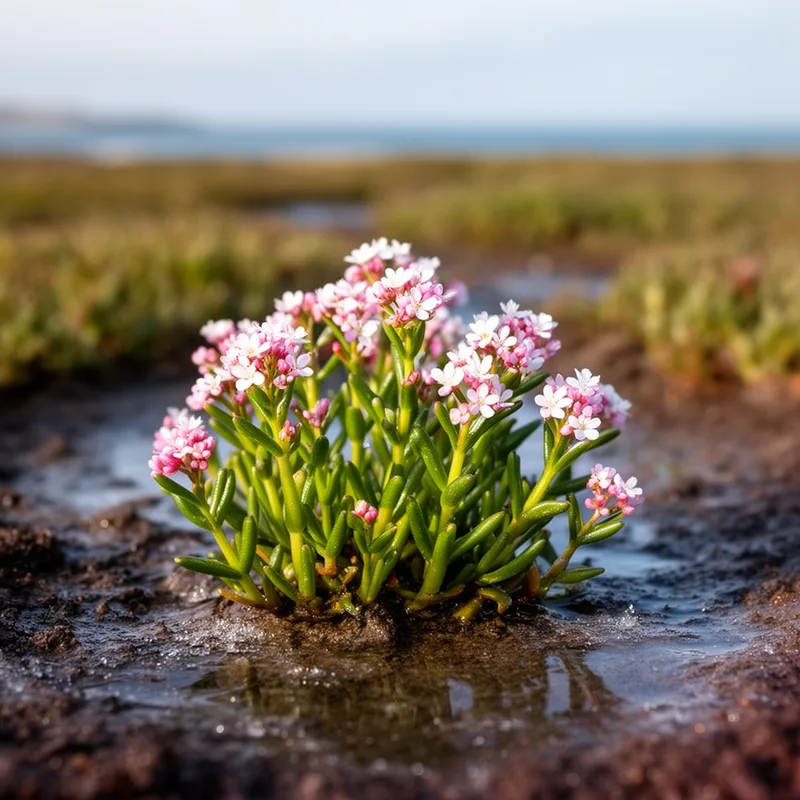
black saltwort
- noun
- US
- Black saltwort is a coastal plant often found along brackish marshes and sandy shores.
Examples
-
The succulent stems of black saltwort help it survive the salty environment.
-
Black saltwort is often found thriving in tidal marshlands along the Atlantic coast.
-
Botanists are studying how black saltwort adapts to changing shoreline conditions.
-
The black saltwort grows abundantly along the coast.
-
Have you seen a black saltwort in bloom?
-
Many birds feed on the seeds of black saltwort found in the wetlands.
-
During summer, the black saltwort produces delicate pink or white flowers near the shoreline.
Synonyms
A small plant with thick leaves and pink or white flowers that grows by the sea and in salty marshes
A small plant with pink or white flowers that grows by the sea
A small plant with thick leaves and pink or white flowers that grows on seashores and marshes
Surface Forms
Morphology
The noun phrase is a straightforward composition of the adjective 'black' (a color) and 'saltwort' (a coastal, salt-tolerant plant), so its meaning — a saltwort that is black or dark-colored — is directly derivable from the parts. This follows the regular adjective + noun pattern common across languages, so a B1 learner who knows both constituents would readily understand the MWE.
Etymology
Black saltwort probably comes from the words salt and wort: salt shows it grows in salty places and wort is an old word for a 'plant' or 'herb', while black likely describes dark stems or seed parts. So the name points to a small coastal herb that lives by the sea.

