
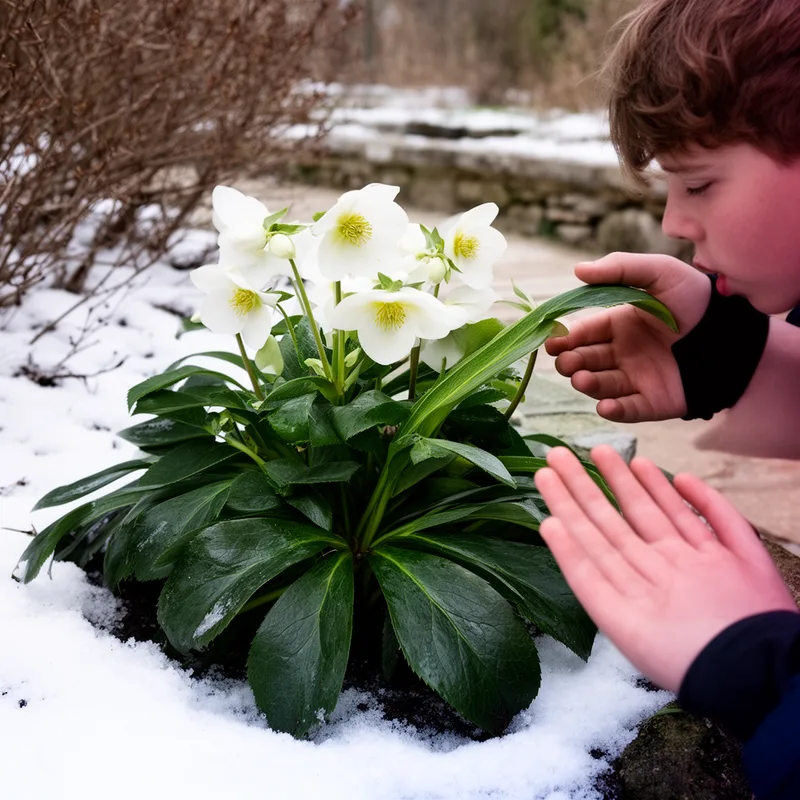
black hellebore
- noun
- /blæk ˈhɛləˌbɔr/
- Specialized
- Caution is advised, as all parts of the black hellebore are toxic if ingested.
Examples
-
The black hellebore is often grown in gardens for its striking winter blooms.
-
She identified the plant as a black hellebore by its characteristic leathery leaves.
-
The black hellebore is known for its beautiful winter blooms.
-
Many gardeners admire the black hellebore for its evergreen foliage.
-
Caution is advised, as all parts of the black hellebore are toxic if ingested.
-
She identified the plant as a black hellebore by its characteristic leathery leaves.
-
The black hellebore is often grown in gardens for its striking winter blooms.
Synonyms
An evergreen plant with white or purple flowers that bloom in winter

A European plant that keeps green leaves and has white or purple flowers in winter
A plant with white or pale purple rose-like flowers that bloom in winter often near Christmas
Surface Forms
Morphology
This is a straightforward adjective + noun composition: a B1 learner who knows 'black' and 'hellebore' will infer it denotes a type/variety of hellebore characterized by the property 'black' (i.e., a plant of that genus with black/darker features). The meaning is fully compositional and follows common noun-phrase modification patterns, so it is immediately derivable from its parts.
Etymology
Black hellebore may come from a simple image: a plant with dark roots and an old name for a poisonous plant. One popular story says people called it black for its dark root and hellebore because it was known to be 'poisonous', so the name reminds us it is a winter flower that is dangerous to eat.

