
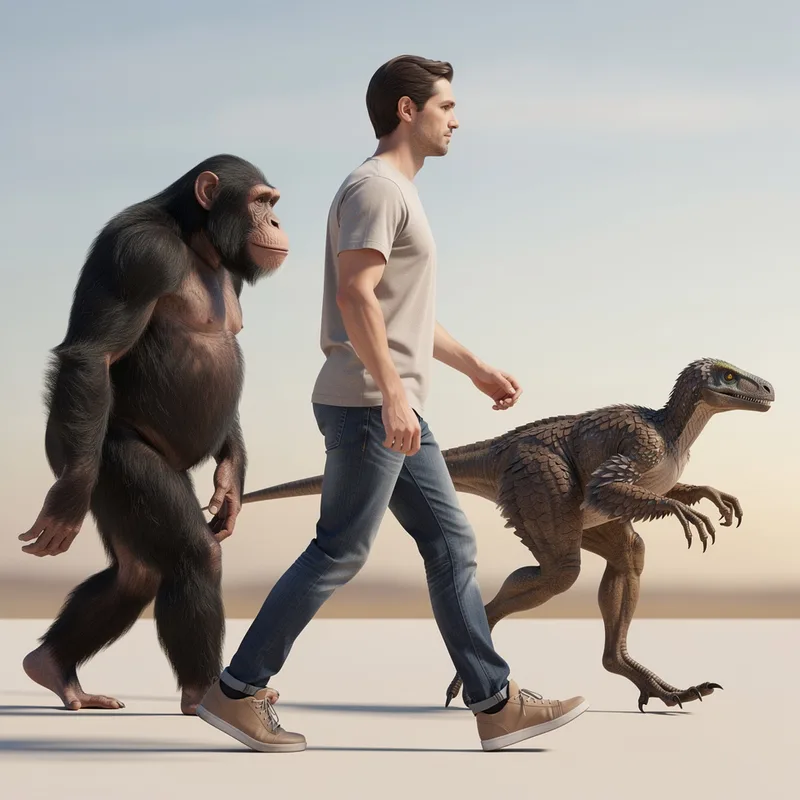
bipedalism
 1
7.3

- noun
- /ˌbaɪˈpɛdəlɪzəm/
- Specialized
- The adaptation of bipedalism was crucial for freeing the hands for tool use.
- explain bipedalism
- led to bipedalism
Loading YouTube…
Watch on YouTubeBut the benefits that we get from standing upright outweigh the costs that come with bipedalism.
- But the benefits that we get from standing upright outweigh the costs that come with bipedalism.
Examples
-
The evolution of bipedalism marked a significant adaptation in human ancestors.
-
One was that they proved bipedalism had emerged much earlier than had been believed.
Academic text (1995) -
Crawling was little developed, and forms of bipedalism developed only very gradually.
Academic text (1998) -
Most of the animal behavior normally cited consists of static bipedalism, such as rising on two legs to look out for predators or gather food.
Academic text (1995) -
Two very different books, then, present radically different scenarios for the origin of bipedalism in our lineage.
Academic text (2003) -
Yes, in retrospect, bipedalism opened up a huge range of radical new possibilities for hominids.
Academic text (2003) -
All these widely varied attempts to explain bipedalism concentrate on imagining what advantages might have been gained from it.
Academic text (1995) -
An opposing camp argues that bipedalism is simply the most energy-efficient way for a hominid to get around on a flat surface.
Academic text (2003) -
One of the most significant of the evolutionary "scars" imposed by the habitual bipedalism of the protohominids is a shortening of the pelvic opening, making childbirth much more difficult and painful for humans than it is for other apes.
Academic text (1995) -
Research on bipedalism explains how early humans developed walking upright.
Surface Forms
Morphology
Etymology
The word bipedalism comes from bi- 'two' and ped 'foot', like in pedal or pedestrian, so it means walking on 'two' feet.